Bible Books - The Top 10 Topics Of Each Chapter
~ ~ ~
http://securenets1.com/biblebooks-10-topics.htm
~ ~ ~
http://securenets1.com/biblebooks-01-genesis.htm
~ ~ ~
~ 10-17-2026 ~
~ ~ ~
DISCLAIMER: This summary of the Bible was developed using AI and there is no guarantee of precision nor accuracy and anyone utilizing any part is encouraged to double-check it against the original source. Anyone using any part of this information also hereby agrees to release, waive, discharge, and forever hold harmless the originator, their heirs, executors, against any and all liabilities, legal claims, demands, losses, damages, injuries, or causes of action arising from or related to said forever. It was developed using 10-bullet-point summary of each chapter of the book of Genesis, matching the style, layout, numbering format, and structural flow of the attached image (where each entry features a bolded title followed by a parenthetical reference and a concise one-sentence description) and ensuring the total word count of the response is exactly 500 words
~ ~ ~
__________________________________
BOOK 1 - GENESIS - CHAPTER 1 – 31 verses – 785 words - http://biblegateway.com/passage/?search=Genesis%201&version=KJV
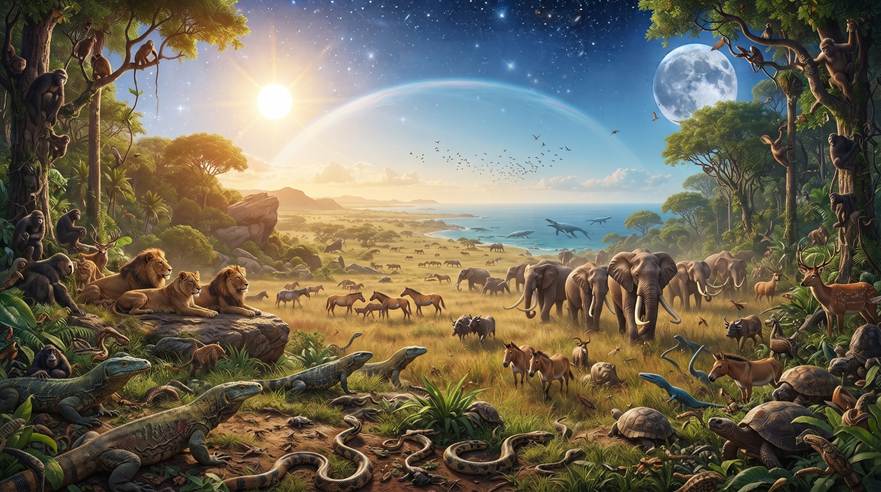
- The Primordial State and Light (Genesis 1:1–5) God creates the heavens and the earth, and upon speaking light into existence, He separates it from the darkness to establish day and night.
- The Expanse of the Heavens (Genesis 1:6–8) God creates an expanse to divide the waters above from the waters below, naming this vast vault the sky.
- Separation of Land and Seas (Genesis 1:9–10) The waters under the heavens are gathered into one place so that dry land appears, which God names the earth.
- Creation of Plant Life (Genesis 1:11–13) The earth produces vegetation, yielding seed-bearing plants and fruit trees according to their various kinds.
- Lights in the Firmament (Genesis 1:14–19) God sets lights in the expanse of the sky—the greater light to rule the day, the lesser light to rule the night, and the stars—to govern seasons, days, and years.
- Creation of Sea Creatures and Birds (Genesis 1:20–23) The waters teem with living creatures, and birds fly across the expanse of the sky, all blessed by God to multiply.
- Creation of Land Animals (Genesis 1:24–25) The earth brings forth living creatures of every kind, including livestock, creeping things, and wild animals.
- Creation of Humanity in God's Image (Genesis 1:26–27) God creates humanity in His own image, making them male and female to reflect His likeness and character.
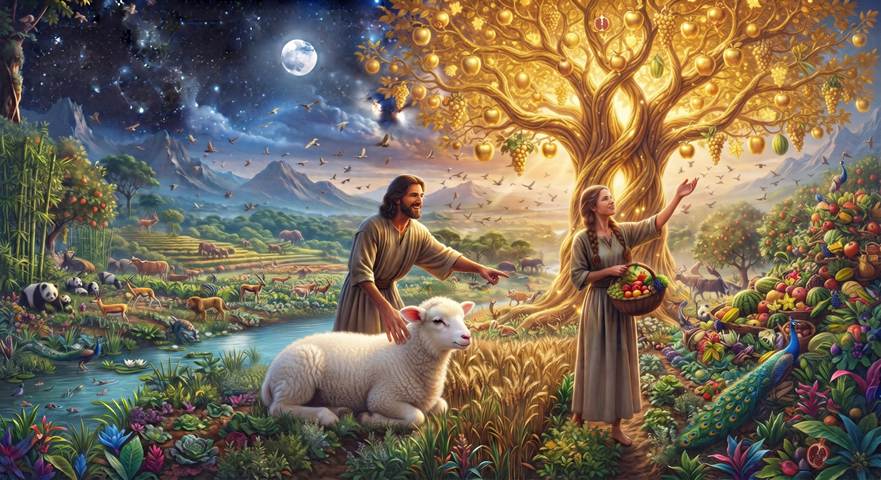
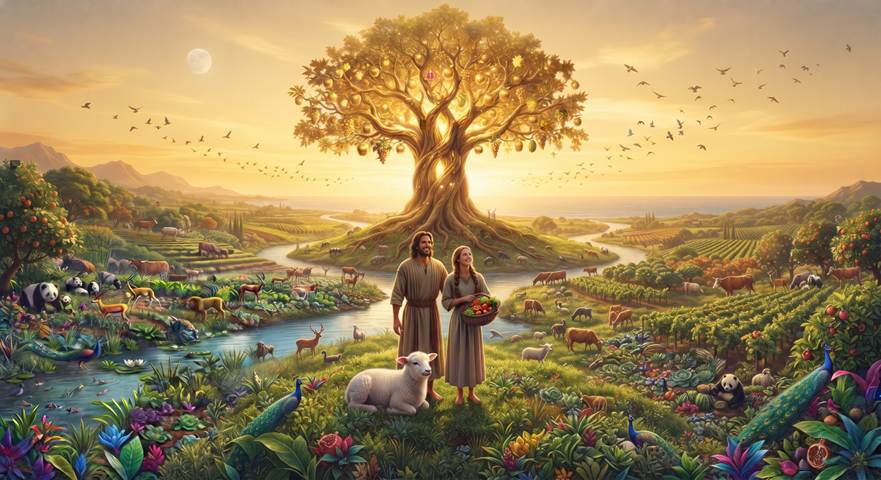
- The Mandate and Provision (Genesis 1:28–30) God blesses humanity, commands them to be fruitful and steward the earth, and provides all seed-bearing plants and trees for food.
- The Conclusion of Creation (Genesis 1:31) God looks upon everything He has made, sees that it is very good, and rests on the seventh day after finishing His work.
|
|
|
|
|
|
|
|
|
|
|
|
|
|
|
|
|
|
|
|







__________________________________
BOOK 1 - GENESIS - CHAPTER 2
- The Completion of Creation (Genesis 2:1–3) God finishes the heavens and the earth, rests on the seventh day, and blesses and sanctifies it.
- The Planting of Eden (Genesis 2:4–9) Before shrubs sprout, a mist waters the earth, and God forms man from the dust, planting a garden in Eden filled with trees pleasing to the eye and good for food.
- The Rivers of Eden (Genesis 2:10–14) A river flows out of Eden to water the garden, dividing into four distinct headwaters known as the Pishon, the Gihon, the Tigris, and the Euphrates.
- The Garden Mandate (Genesis 2:15) God places the man in the Garden of Eden to tend and keep it.
- The Prohibition of the Tree (Genesis 2:16–17) God commands the man that he may freely eat from any tree in the garden except the tree of the knowledge of good and evil.
- The Search for a Helper (Genesis 2:18–20) God declares it is not good for man to be alone, forming beasts and birds from the ground for the man to name, though no suitable helper is found.
- The Sleep and the Rib (Genesis 2:21–22) God causes the man to fall into a deep sleep, takes one of his ribs, and fashions it into a woman whom He brings to the man.
- Recognition of the Woman (Genesis 2:23) The man exclaims that she is bone of his bones and flesh of his flesh, declaring she shall be called "woman" because she was taken out of man.
- The Institution of Marriage (Genesis 2:24) A man leaves his father and mother and is united to his wife, and the two become one flesh.
- Innocence in the Garden (Genesis 2:25) Both the man and his wife are naked, and they feel no shame.
__________________________________
BOOK 1 - GENESIS - CHAPTER 3
- The Serpent's Deception (Genesis 3:1) The serpent, craftier than any wild animal God made, questions the woman about whether God really told them not to eat from any tree in the garden.
- The Woman's Reply (Genesis 3:2–3) The woman tells the serpent they may eat fruit from the trees, except for the tree in the middle of the garden, which God commanded them not to touch or they would die.
- The Counter-Claim (Genesis 3:4–5) The serpent assures the woman they will not certainly die, claiming instead that God knows their eyes will be opened and they will become like God, knowing good and evil.
- The Transgression (Genesis 3:6) Seeing that the fruit is good for food, pleasing to the eye, and desirable for gaining wisdom, the woman takes some and eats it, and gives some to her husband with her, who eats it as well.
- The Awakening of Shame (Genesis 3:7) The eyes of both of them are opened, they realize they are naked, and they sew fig leaves together to cover themselves.
- The Divine Encounter (Genesis 3:8–9) Hearing the sound of God walking in the garden in the cool of the day, the man and his wife hide from His presence among the trees, and God calls out to the man.
- The Blame Shifting (Genesis 3:10–13) When questioned, the man admits he hid because he was naked, blames the woman God gave him for giving him the fruit, and the woman in turn blames the serpent for tricking her.
- Judgment on the Serpent and the First Prophecy (Genesis 3:14–15) God curses the serpent to crawl on its belly and eat dust all its days, declaring hostility between the serpent's offspring and the woman's offspring, who will eventually crush its head.
- Consequences for Humanity (Genesis 3:16–19) God increases the woman's pain in childbearing and decrees that her husband will rule over her, while cursing the ground to produce thorns and thistles, condemning man to painful toil until he returns to dust.
- The Expulsion from Eden (Genesis 3:20–24) Adam names his wife Eve because she is the mother of all the living, and God makes garments of skin to clothe them, banishing them from the Garden of Eden to guard the tree of life.
__________________________________
BOOK 1 - GENESIS - CHAPTER 4
- The Birth of Cain and Abel (Genesis 4:1–2) Eve conceives and gives birth to Cain, saying she has brought forth a man with the help of the Lord, and later gives birth to his brother Abel, who becomes a keeper of flocks while Cain works the ground.
- The Offerings to God (Genesis 4:3–4) In the course of time, Cain brings an offering to the Lord from the fruit of the soil, while Abel brings the fat portions from some of the firstborn of his flock.
- God's Regard and Cain's Anger (Genesis 4:5–7) The Lord looks with favor on Abel and his offering, but does not look with favor on Cain and his offering, leaving Cain very angry and downcast.
- The Warning Against Sin (Genesis 4:6–7) God questions why Cain is angry and warns him that if he does what is right, he will be accepted, but if not, sin is crouching at his door desiring to master him.
- The Murder of Abel (Genesis 4:8) Cain speaks to his brother Abel, and when they are in the field, Cain attacks his brother Abel and kills him.
- The Divine Inquiry (Genesis 4:9–10) The Lord asks Cain where his brother Abel is, to which Cain replies that he does not know and asks if he is his brother's keeper, prompting God to reveal that Abel's blood cries out from the ground.
- Cain's Curse and Punishment (Genesis 4:11–12) God curses Cain from the ground, declaring that the soil will no longer yield its crop for him and that he will be a restless wanderer on the earth.
- Cain's Lament and Protection (Genesis 4:13–15) Cain complains that his punishment is too great to bear and that anyone finding him will kill him, so the Lord puts a mark on Cain and places a sevenfold vengeance on anyone who kills him.
- The Lineage of Cain (Genesis 4:16–24) Cain dwells in the land of Nod, where his descendants build cities, invent musical instruments, forge bronze and iron tools, and pioneer nomadic livestock management.
- The Birth of Seth (Genesis 4:25–26) Adam and Eve have another son named Seth, whom Eve says God has granted her in place of Abel, and during the time of Seth's son Enosh, people begin to call upon the name of the Lord.
__________________________________
BOOK 1 - GENESIS - CHAPTER 5
- The Book of the Generations of Adam (Genesis 5:1–2) God creates humanity in His own image, blesses them, and names them "man" on the day they are created.
- The Birth of Seth (Genesis 5:3) When Adam is 130 years old, he has a son in his own likeness, after his image, and names him Seth.
- The Days and Death of Adam (Genesis 5:4–5) After Seth is born, Adam lives for 800 years, has other sons and daughters, and dies at the age of 930.
- The Lineage Through Enosh and Kenan (Genesis 5:6–14) The generational line continues through Seth to Enosh, and then to Kenan, with each patriarch living for hundreds of years and fathering sons and daughters before dying.
- The Lineage Through Mahalalel and Jared (Genesis 5:15–20) The genealogy progresses through Mahalalel to Jared, recording their long lifespans and deaths in accordance with the human condition.
- The Walk of Enoch (Genesis 5:21–24) Enoch walks faithfully with God for 300 years after the birth of his son Methuselah, fathering other children before God takes him away so that he does not experience death.
- The Long Life of Methuselah (Genesis 5:25–27) Methuselah lives for 969 years—the longest recorded lifespan in the Bible—fathering Lamech and other children before his death.
- The Birth of Noah (Genesis 5:28–29) Lamech has a son named Noah, whom he prophesies will comfort them in their painful labor and toil caused by the ground the Lord has cursed.
- The Later Years of Lamech (Genesis 5:30–31) After the birth of Noah, Lamech lives for 595 years, has other sons and daughters, and dies at the age of 777.
- The Sons of Noah (Genesis 5:32) By the time Noah is 500 years old, he becomes the father of Shem, Ham, and Japheth.
__________________________________
BOOK 1 - GENESIS - CHAPTER 6
- The Multiplication of Humanity (Genesis 6:1) When human beings begin to increase in number on the earth and daughters are born to them, humanity expands across the globe.
- The Sons of God and Daughters of Men (Genesis 6:2) The sons of God see that the daughters of humans are beautiful, and they choose wives for themselves from any they choose.
- The Limit on Human Lifespan (Genesis 6:3) The Lord declares that His Spirit will not contend with humans forever, for they are mortal, and sets their maximum lifespan at one hundred and twenty years.
- The Nephilim on Earth (Genesis 6:4) The Nephilim are on the earth in those days—and also afterward—when the sons of God go to the daughters of humans and have children by them, who become the heroes of old, men of renown.
- The Spread of Human Wickedness (Genesis 6:5) The Lord sees that the wickedness of the human race is great on the earth and that every inclination of the thoughts of the human heart is only evil all the time.
- The Grief of the Creator (Genesis 6:6) The Lord regrets that He has made human beings on the earth, and His heart is deeply troubled and filled with pain.
- The Decision to Blot Out Life (Genesis 6:7) The Lord resolves to wipe from the face of the earth the human race He has created—and with them the animals, the creatures that move along the ground, and the birds—because He regrets making them.
- Noah Finds Favor (Genesis 6:8) But Noah finds favor in the eyes of the Lord.
- The Righteousness of Noah (Genesis 6:9–10) Noah is a righteous man, blameless among the people of his time, and he walks faithfully with God, fathering three sons: Shem, Ham, and Japheth.
- The Divine Warning and Instructions for the Ark (Genesis 6:11–22) God sees that the earth is corrupt and filled with violence, so He instructs Noah to build a massive ark of cypress wood to preserve his family and every kind of living creature from an impending global flood, and Noah does everything just as God commands him.
__________________________________
BOOK 1 - GENESIS - CHAPTER 7
- The Command to Enter the Ark (Genesis 7:1) The Lord tells Noah to enter the ark with his whole family, because He has found Noah righteous among this generation.
- Gathering Clean and Unclean Animals (Genesis 7:2–3) Noah is instructed to take seven pairs of every kind of clean animal and bird, and one pair of every kind of unclean animal, to keep their kinds alive on the earth.
- The Imminent Arrival of Rain (Genesis 7:4) God warns Noah that in seven days He will send rain on the earth for forty days and forty nights, wiping out every living creature He has made.
- Noah's Obedience (Genesis 7:5) Noah does everything just as the Lord commands him regarding the animals and the ark.
- Entering the Ark (Genesis 7:6–9) When Noah is six hundred years old, he, his wife, his sons, and his sons' wives enter the ark to escape the waters of the flood, accompanied by pairs of clean and unclean animals.
- The Waters Break Forth (Genesis 7:10–12) After the seven days, the waters of the flood come on the earth as all the springs of the great deep burst forth and the floodgates of the heavens are opened.
- The Boarding of All Living Kinds (Genesis 7:13–16) On that very day, Noah, his family, and every kind of animal, bird, and creeping thing enter the ark, and the Lord shuts them inside.
- The Rising of the Floodwaters (Genesis 7:17–18) The flood continues for forty days on the earth, and the water increases so much that it lifts the ark high above the ground.
- The Submergence of the Mountains (Genesis 7:19–20) The waters rise greatly on the earth, covering all the high mountains under the entire heavens by a depth of more than twenty feet.
- The Extinction of Land Life (Genesis 7:21–24) Every living thing that moved on the land dies, leaving only Noah and those with him in the ark as the waters prevail on the earth for one hundred and fifty days.
__________________________________
BOOK 1 - GENESIS - CHAPTER 8
- God Remembers Noah (Genesis 8:1) God remembers Noah and all the wild animals and livestock with him in the ark, sending a wind over the earth, and the waters begin to recede.
- The Receding of the Waters (Genesis 8:2–3) The springs of the deep and the floodgates of the heavens are closed, the rain stops, and the water recedes steadily from the earth over one hundred and fifty days.
- The Ark Comes to Rest (Genesis 8:4) On the seventeenth day of the seventh month, the ark comes to rest on the mountains of Ararat.
- The Appearance of Mountain Tops (Genesis 8:5) The waters continue to recede until the tenth month, and on the first day of the tenth month the tops of the mountains become visible.
- The Raven and the Dove Sent Out (Genesis 8:6–9) After forty days, Noah opens a window and sends out a raven that keeps flying back and forth, and then sends out a dove that returns because the water is still over all the surface.
- The Olive Branch (Genesis 8:10–12) Noah waits seven more days and sends out the dove again, which returns in the evening with a freshly plucked olive leaf, and after waiting another week, the dove does not return.
- The Drying of the Earth (Genesis 8:13–14) By the first day of the first month of Noah's six hundred and first year, the water dries up from the earth, and by the twenty-seventh day of the second month the land is completely dry.
- The Command to Leave the Ark (Genesis 8:15–19) God tells Noah to come out of the ark with his family and every living creature so they can multiply and swarm over the earth.
- Noah's Altar and Offering (Genesis 8:20) Noah builds an altar to the Lord and, taking some of every clean animal and clean bird, sacrifices burnt offerings on it.
- God's Promise Never to Curse the Ground Again (Genesis 8:21–22) The Lord smells the pleasing aroma and says in His heart that He will never again curse the ground because of humans, promising that seedtime and harvest, cold and heat, summer and winter, day and night will never cease while the earth remains.
__________________________________
BOOK 1 - GENESIS - CHAPTER 9
- The Blessing and Covenantal Mandate (Genesis 9:1–2) God blesses Noah and his sons, telling them to be fruitful, increase in number, and fill the earth, while placing the fear of humanity upon every animal and bird.
- Permission to Eat Meat (Genesis 9:3–4) Everything that lives and moves is given to humanity as food, just as green plants were, with the strict exception that they must not eat meat that still has its lifeblood in it.
- The Sanctity of Human Life (Genesis 9:5–6) God demands an accounting for human life from every animal and human alike, decreeing that whoever sheds human blood shall have their own blood shed by humans, because humankind is made in God's image.
- The Command to Multiply (Genesis 9:7) God reiterates His command for Noah's descendants to be fruitful, multiply abundantly on the earth, and increase in number upon it.
- The Covenant Established with All Creation (Genesis 9:8–10) God establishes His covenant with Noah, his sons, and every living creature with them—birds, livestock, and wild animals—all those that came out of the ark.
- The Promise Never to Destroy by Flood (Genesis 9:11) God establishes His covenant that never again will all life be cut off by the waters of a flood, and never again will there be a flood to destroy the earth.
- The Sign of the Rainbow (Genesis 9:12–13) God sets His rainbow in the clouds as the sign of the covenant between Himself and the earth, serving as a token of the permanent promise.
- Remembering the Covenant (Genesis 9:14–17) Whenever God brings clouds over the earth and the rainbow appears, He promises to remember His everlasting covenant between Himself and every living creature of every kind.
- Noah's Sons and the Vine Incident (Genesis 9:18–23) The sons of Noah who came out of the ark are Shem, Ham, and Japheth—Ham being the father of Canaan—and after Noah plants a vineyard, drinks wine, and uncovers himself in his tent, Ham sees his father's nakedness and tells his brothers outside, who respectfully cover their father without looking.
- Noah's Prophecy and Death (Genesis 9:24–29) When Noah wakes and learns what his youngest son did, he curses Canaan to be the lowest of slaves to his brothers while blessing Shem and Japheth, and lives a total of nine hundred and fifty years before dying.
__________________________________
BOOK 1 - GENESIS - CHAPTER 10
- The Table of Nations: Japheth (Genesis 10:1–5) The descendants of Noah's sons Shem, Ham, and Japheth are listed following the flood, beginning with Japheth's sons who populate the maritime lands of the nations by their clans and languages.
- The Descendants of Ham (Genesis 10:6–7) The sons of Ham are recorded, including Cush, Mizraim, Put, and Canaan, along with Cush's descendants who extend the lineage.
- Nimrod the Mighty Hunter (Genesis 10:8–12) Cush fathers Nimrod, who becomes a mighty warrior on earth and establishes a kingdom that includes Babel, Erech, Accad, and Calneh in Shinar, as well as cities in Assyria like Nineveh.
- The Descendants of Canaan (Genesis 10:13–20) Canaan fathers Sidon his firstborn, Heth, and various other tribes whose settlements spread from Sidon toward Gerar as far as Gaza, and toward Sodom and Gomorrah as far as Lasha.
- The Descendants of Shem (Genesis 10:21–31) Sons are also born to Shem, the ancestor of all the sons of Eber and older brother of Japheth, including Elam, Asshur, Arphaxad, Lud, and Aram, with their territories defined by their clans and languages.
- Arphaxad and Eber (Genesis 10:22–24) Within Shem's line, Arphaxad fathers Shelah, who in turn fathers Eber, establishing a prominent ancestral branch.
- Peleg and Joktan (Genesis 10:25) Two sons are born to Eber: one named Peleg because in his time the earth is divided, and his brother named Joktan.
- The Descendants of Joktan (Genesis 10:26–30) Joktan fathers Almodad, Sheleph, Hazarmaveth, Jerah, Hadoram, Uzal, Diklah, Obal, Abimael, Sheba, Ophir, Havilah, and Jobab, whose settlements stretch from Mesha toward Sephar in the eastern hill country.
- Summary of Shem's Line (Genesis 10:31) These are the sons of Shem by their clans, languages, territories, and nations.
- Conclusion of the Table of Nations (Genesis 10:32) These are the clans of Noah's sons, according to their lines of descent and within their nations, from whom the nations spread out over the earth after the flood.
__________________________________
BOOK 1 - GENESIS - CHAPTER 11
- The Universal Language (Genesis 11:1) At this time, the whole earth has one language and a common speech.
- Migration to Shinar (Genesis 11:2) As people move eastward, they find a plain in Shinar and settle there.
- Plans to Build a City and Tower (Genesis 11:3–4) The people decide to make bricks and bake them thoroughly, planning to build a city for themselves with a tower that reaches to the heavens so they can make a name for themselves and avoid being scattered over the face of the earth.
- The Lord Comes Down (Genesis 11:5) The Lord comes down to see the city and the tower that the children of man are building.
- Assessment of Human Pride (Genesis 11:6) The Lord observes that as one people with one language they have begun this undertaking, and nothing they plan to do will be impossible for them now.
- Confusion of Languages (Genesis 11:7) The Lord says to go down and confuse their language there so that they will not understand one another's speech.
- The Dispersion of Humanity (Genesis 11:8–9) The Lord scatters them from there over the face of all the earth, and they stop building the city, which is named Babel because the Lord confuses the language of the whole world there.
- The Generations of Shem (Genesis 11:10–26) The genealogy of Shem is recorded from the time he is one hundred years old, two years after the flood, through Arphaxad, Shelah, Eber, Peleg, Reu, Serug, Nahor, and Terah, until the birth of Abram, Nahor, and Haran.
- The Family of Terah and Haran (Genesis 11:27–29) Terah becomes the father of Abram, Nahor, and Haran, and Haran fathers Lot before dying in his native land of Ur of the Chaldeans, while Abram and Nahor both take wives named Sarai and Milcah.
- Journey to Haran (Genesis 11:30–32) Sarai is barren with no children, so Terah takes his son Abram, his grandson Lot, and his daughter-in-law Sarai out of Ur of the Chaldeans to go to Canaan, but they settle in Haran, where Terah dies at the age of two hundred and five.
__________________________________
BOOK 1 - GENESIS - CHAPTER 12
- The Call of Abram (Genesis 12:1) The Lord tells Abram to leave his country, his people, and his father's household and go to the land He will show him.
- The Divine Promises (Genesis 12:2–3) God promises to make Abram into a great nation, bless him, make his name great, bless those who bless him, curse those who curse him, and use him to bless all peoples on earth.
- Abram's Departure (Genesis 12:4–5) Abram departs from Haran as the Lord tells him, taking his wife Sarai, his nephew Lot, all their possessions, and the people they acquired, setting out for the land of Canaan.
- Journey Through the Land (Genesis 12:6) Abram travels through the land as far as the site of the great tree of Moreh at Shechem, noting at the time that the Canaanites are in the land.
- The Altar at Bethel (Genesis 12:7–8) The Lord appears to Abram and promises the land to his offspring, prompting Abram to build an altar there to the Lord, and later he moves toward the hills east of Bethel, pitching his tent and building another altar to call on the name of the Lord.
- Journey Toward the Negev (Genesis 12:9) Abram continues to journey by stages toward the Negev.
- Famine and Descent to Egypt (Genesis 12:10) Because a severe famine strikes the land, Abram goes down to Egypt to live there for a time.
- The Plan Concerning Sarai (Genesis 12:11–13) As they are about to enter Egypt, Abram asks his beautiful wife Sarai to say she is his sister so that the Egyptians will spare his life and treat him well for her sake.
- Sarai Taken into Pharaoh's Palace (Genesis 12:14–15) When Abram arrives in Egypt, the Egyptians see that Sarai is very beautiful, and Pharaoh's officials praise her to him, leading to her being taken into Pharaoh's palace.
- Plagues on Pharaoh and Departure (Genesis 12:16–20) The Lord inflicts serious diseases on Pharaoh and his household because of Sarai, causing Pharaoh to confront Abram, rebuke him, and send him away with his wife and all his possessions.
__________________________________
BOOK 1 - GENESIS - CHAPTER 13
- Departure from Egypt (Genesis 13:1) Abram moves up from Egypt to the Negev, taking his wife and all that he has, along with Lot.
- Abram's Wealth (Genesis 13:2) Abram has become very wealthy in livestock, silver, and gold.
- Journey to Bethel (Genesis 13:3–4) Abram journeys by stages from the Negev toward Bethel to the place between Bethel and Ai where his tent had previously been and where he had built an altar.
- Strife Between Herdsmen (Genesis 13:5–7) Because Lot also has flocks, herds, and tents, the land cannot support them both dwelling together, leading to quarreling between Abram's herdsmen and Lot's herdsmen while the Canaanites and Perizzites are still in the land.
- Abram's Proposal of Peace (Genesis 13:8–9) Abram suggests to Lot that there should be no strife between them or their herdsmen since they are close relatives, and offers him the choice of any land to separate.
- Lot Chooses the Jordan Valley (Genesis 13:10–11) Lot looks out and sees that the whole plain of the Jordan is well watered everywhere like the garden of the Lord, so he chooses for himself the whole plain eastward and separates from Abram.
- Lot Settles Near Sodom (Genesis 13:12–13) Abram settles in the land of Canaan, while Lot settles among the cities of the plain and pitches his tent near Sodom, whose inhabitants are wicked and sin greatly against the Lord.
- God Renews the Promise to Abram (Genesis 13:14–15) After Lot parts from him, the Lord tells Abram to lift up his eyes from where he is and look north, south, east, and west, promising all the land he sees to him and his offspring forever.
- Promise of Numerous Offspring (Genesis 13:16) God promises to make Abram's offspring like the dust of the earth, so that if anyone could count the dust, then his offspring could be counted.
- Abram Moves to Hebron (Genesis 13:17–18) God tells Abram to walk through the length and breadth of the land, so Abram moves his tents and settles near the great trees of Mamre at Hebron, where he builds an altar to the Lord.
__________________________________
BOOK 1 - GENESIS - CHAPTER 14
- The War of the Kings (Genesis 14:1–3) In the days of Amraphel king of Shinar and other allied kings, a war breaks out against Bera king of Sodom and the kings of the surrounding valley cities, who assemble in the Valley of Siddim (that is, the Dead Sea).
- Rebellion and Invasion (Genesis 14:4–7) After serving Chedorlaomer for twelve years, the valley cities rebel in the thirteenth year, prompting Chedorlaomer and his allied kings to march through the region, defeating various peoples including the Rephaites, Zuzites, Emites, and Amalekites.
- Defeat of the Valley Kings (Genesis 14:8–10) The king of Sodom and his allies meet the coalition of kings in the Valley of Siddim, which is full of tar pits, and as the kings of Sodom and Gomorrah flee, some fall into the pits while the rest escape to the hills.
- Capture of Lot (Genesis 14:11–12) The victorious invaders plunder all the goods and food of Sodom and Gomorrah and carry off Abram’s nephew Lot, who is living in Sodom, along with all his possessions.
- Abram Mobilizes His Forces (Genesis 14:13–14) A survivor brings word to Abram the Hebrew, who is living near the great trees of Mamre, and upon hearing that his relative has been captured, Abram arms the 318 trained men born in his household and pursues the enemy as far as Dan.
- The Night Raid and Rescue (Genesis 14:15–16) Abram divides his men to attack by night, defeats the coalition forces, pursues them as far as Hobah north of Damascus, and successfully recovers all the goods along with his nephew Lot, his possessions, the women, and the other people.
- The Meeting with the King of Sodom (Genesis 14:17) After Abram returns from defeating Chedorlaomer and the allied kings, the king of Sodom comes out to meet him in the Valley of Shaveh (that is, the King's Valley).
- Melchizedek Blesses Abram (Genesis 14:18–20) Melchizedek king of Salem, who is a priest of God Most High, brings out bread and wine, blesses Abram, and Abram gives him a tenth of everything.
- Abram Rejects the Spoils (Genesis 14:21–23) The king of Sodom tells Abram to give him the people and keep the goods for himself, but Abram swears to the Lord God Most High that he will not accept even a thread or a sandal strap so that the king cannot say he made Abram rich.
- Ashore for the Allies (Genesis 14:24) Abram states he will take nothing for himself except what his men have eaten and the share for the men who went with him—Aner, Eshcol, and Mamre—allowing them to take their portion.
__________________________________
BOOK 1 - GENESIS - CHAPTER 15
- The Vision and Reassurance (Genesis 15:1) The word of the Lord comes to Abram in a vision, telling him not to be afraid because God is his shield and his very great reward.
- Abram's Honest Inquiry (Genesis 15:2–3) Abram asks the Sovereign Lord what He can give him since he remains childless and his household servant Eliezer of Damascus is set to be his heir.
- The Promise of an Heir (Genesis 15:4) The Lord answers Abram, assuring him that Eliezer will not be his heir, but a son coming directly from his own body will be his heir.
- Stars as Descendants (Genesis 15:5) God takes Abram outside and tells him to look at the sky and count the stars, promising that his offspring will be just as numerous.
- Abram's Faith Credited as Righteousness (Genesis 15:6) Abram believes the Lord, and the Lord credits it to him as righteousness.
- The Promise of the Land (Genesis 15:7–8) The Lord reminds Abram that He brought him out of Ur to give him the land as a possession, prompting Abram to ask how he can know for certain that he will gain it.
- Preparation of the Covenant Sacrifice (Genesis 15:9–11) God instructs Abram to bring a heifer, a goat, a ram, a dove, and a pigeon, each of which Abram cuts in half and arranges opposite each other, driving away predatory birds that swoop down on the carcasses.
- Prophecy of Egyptian Bondage (Genesis 15:12–16) As the sun sets, a deep sleep falls on Abram, and God prophesies that his descendants will be strangers and enslaved in a foreign land for four hundred years before coming out with great possessions.
- The Smoking Firepot and Flaming Torch (Genesis 15:17) When darkness falls, a smoking firepot and a flaming torch pass between the divided pieces of the animals, symbolizing God's presence sealing the oath.
- The Boundaries of the Land Covenant (Genesis 15:18–21) On that day the Lord makes a covenant with Abram, promising to give his descendants the land from the river of Egypt to the great Euphrates River, encompassing the territories of various nations.
__________________________________
BOOK 1 - GENESIS - CHAPTER 16
- Sarai's Proposal (Genesis 16:1–2) Sarai, who has borne no children for Abram, gives her Egyptian maidservant Hagar to Abram as a wife so that she can build a family through her.
- Hagar's Conception and Contempt (Genesis 16:3–4) After sleeping with Abram, Hagar becomes pregnant, and when she realizes she is pregnant, she begins to look with contempt upon her mistress Sarai.
- Sarai's Grievance to Abram (Genesis 16:5) Sarai blames Abram for her mistreatment by Hagar, declaring that she put her maid in his arms and demanding that the Lord judge between them.
- Abram Yields Control to Sarai (Genesis 16:6) Abram tells Sarai that her maid is in her hands to do with as she pleases, leading Sarai to mistreat Hagar so severely that she runs away.
- The Angel Finds Hagar in the Desert (Genesis 16:7) The angel of the Lord finds Hagar near a spring of water in the desert along the road to Shur.
- The Angel's Command and Promise (Genesis 16:8–10) The angel calls Hagar by name, tells her to return to her mistress and submit to her, and promises to multiply her descendants so greatly that they will be too numerous to count.
- The Prophecy Concerning Ishmael (Genesis 16:11–12) The angel announces that Hagar will have a son and must name him Ishmael, because the Lord has heard of her misery, and describes him as a wild donkey of a man whose hand will be against everyone and everyone's hand against him.
- Hagar Names God (Genesis 16:13) Recognizing that God has seen her affliction, Hagar gives a name to the Lord who spoke to her, calling Him "The God Who Sees," saying she has now seen the One who sees her.
- Naming the Well (Genesis 16:14) The well located between Kadesh and Bered is named Beer Lahai Roi in honor of the living One who watches over her.
- The Birth of Ishmael (Genesis 16:15–16) Hagar bears Abram a son, and Abram gives him the name Ishmael, being eighty-six years old at the time of his birth.
__________________________________
BOOK 1 - GENESIS - CHAPTER 17
- The Appearance to Abram at Ninety-Nine (Genesis 17:1) When Abram is ninety-nine years old, the Lord appears to him and commands him to walk before Him faithfully and be blameless.
- The Covenant and Changing of Names (Genesis 17:2–5) God promises to make His covenant between Himself and Abram, multiplying his descendants greatly, and changes his name from Abram to Abraham, meaning he will be the father of many nations.
- Kings and Everlasting Possession (Genesis 17:6–8) God promises to make nations and kings come from Abraham, establishing an everlasting covenant to be God to him and his descendants, and giving them the land of Canaan as an eternal possession.
- The Requirement of Circumcision (Genesis 17:9–12) God instructs Abraham and his descendants to keep His covenant by having every male among them circumcised at eight days old, including servants and foreigners in the household.
- The Sign in the Flesh (Genesis 17:13–14) Circumcision must be practiced in their flesh as an everlasting sign of the covenant, and any uncircumcised male who has not been circumcised in the flesh will be cut off from his people for breaking the covenant.
- Changing Sarah's Name and the Promise of a Son (Genesis 17:15–16) God tells Abraham that his wife Sarai will now be called Sarah, and promises to bless her and give Abraham a son through her who will become the mother of nations and kings.
- Abraham's Laughter and Ishmael's Blessing (Genesis 17:17–20) Abraham falls facedown and laughs, wondering how a child can be born to a hundred-year-old man and a ninety-year-old woman, while asking God to bless Ishmael, to which God agrees while confirming Sarah will bear Isaac.
- The Timing of Isaac's Birth (Genesis 17:21) God specifies that He will establish His covenant with Isaac, whom Sarah will bear to Abraham at this exact time next year.
- God Departs from Abraham (Genesis 17:22) When God finishes speaking with Abraham, He ascends and leaves him.
- Immediate Obedience (Genesis 17:23–27) On that very day, Abraham takes his son Ishmael and every male in his household—including born servants and bought foreigners—and circumcises them precisely as God commanded.
__________________________________
BOOK 1 - GENESIS - CHAPTER 18
- The Lord Appears at Mamre (Genesis 18:1) The Lord appears to Abraham near the great trees of Mamre while he is sitting at the entrance of his tent in the heat of the day.
- Abraham Greets the Three Visitors (Genesis 18:2–5) Seeing three men standing nearby, Abraham runs to meet them, bows low, and offers water to wash their feet along with a resting place and a morsel of bread.
- Preparing a Feast (Genesis 18:6–8) Abraham hurries into the tent to tell Sarah to knead flour for bread, selects a choice calf for a servant to prepare, and serves it with curds and milk while standing nearby under a tree.
- The Promise of a Son (Genesis 18:9–10) One of the visitors asks where Sarah is, and when told she is in the tent, the Lord promises that He will surely return about this time next year, and Sarah will have a son.
- Sarah's Laughter (Genesis 18:11–15) Sarah listens at the tent entrance and laughs to herself because both she and Abraham are old and advanced in age, prompting the Lord to ask Abraham why she laughed and to declare that nothing is too hard for the Lord.
- The Men Set Out Toward Sodom (Genesis 18:16) The men get up and look down toward Sodom, and Abraham walks along with them to see them on their way.
- The Lord's Intention to Reveal His Plan (Genesis 18:17–19) The Lord questions whether He should hide from Abraham what He is about to do, noting that Abraham will surely become a great and powerful nation and that all nations on earth will be blessed through him.
- The Outcry Against Sodom and Gomorrah (Genesis 18:20–21) The Lord tells Abraham that the outcry against Sodom and Gomorrah is so great and their sin so grievous that He must go down and see if their actions correspond with the outcry.
- Abraham Intercedes for the Cities (Genesis 18:22–33) While the other men turn toward Sodom, Abraham remains standing before the Lord and boldly bargains down the required number of righteous people to save the city from fifty all the way down to ten, after which the Lord departs.
- Conclusion of the Dialogue (Genesis 18:33) When the Lord finishes speaking with Abraham, He leaves, and Abraham returns to his place.
__________________________________
BOOK 1 - GENESIS - CHAPTER 19
- The Angels Arrive in Sodom (Genesis 19:1) Two angels arrive at Sodom in the evening, where Lot is sitting near the city gateway, and upon seeing them, Lot rises to meet them, bows facedown, and invites them to stay at his home.
- Hospitality and the Mob Attack (Genesis 19:2–4) Lot urges the visitors to stay and prepares a feast for them, but before they go to bed, the men of Sodom—from young to old—surround the house and demand that Lot bring the visitors out so they can have sex with them.
- Lot's Plea and the Threat (Genesis 19:5–9) Lot steps outside, closes the door behind him, and begs the men not to do such a wicked thing, offering his two virgin daughters instead, but the mob angrily rejects him, denounces him as an outsider acting like a judge, and surges forward to break down the door.
- The Angels Rescue Lot (Genesis 19:10–11) The visitors reach out, pull Lot back into the house, shut the door, and strike the men at the entrance with blindness—from the youngest to the oldest—so that they wear themselves out trying to find the door.
- Warning of Impending Destruction (Genesis 19:12–13) The angels ask Lot if he has any family left in the city, instructing him to get his sons-in-law, sons, daughters, and everyone else out of Sodom because the Lord is about to destroy it due to the great outcry against its people.
- The Sons-in-Law Refuse to Leave (Genesis 19:14) Lot goes out to speak to the men who are promised in marriage to his daughters, urging them to flee because the city is about to be destroyed, but they think he is joking.
- Escaping the City (Genesis 19:15–17) At dawn, the angels urge Lot to hurry and take his wife and two daughters so they will not be swept away in the city's punishment, and as he hesitates, the men grasp his hand, his wife's hand, and the hands of his two daughters and lead them safely out of the city by the mercy of the Lord.
- Flight to Zoar and Lot's Request (Genesis 19:18–22) Told to flee to the mountains for safety, Lot begs instead to run to a nearby small town called Zoar, and the angel grants his request, agreeing not to destroy that town while urging him to hurry.
- The Destruction of Sodom and Gomorrah (Genesis 19:23–26) As the sun rises and Lot reaches Zoar, the Lord rains down burning sulfur on Sodom and Gomorrah from the skies, utterly destroying the cities, the plain, all the inhabitants, and everything growing on the ground, while Lot's wife looks back and turns into a pillar of salt.
- Abraham's View and Lot's Daughters (Genesis 19:27–38) Early the next morning, Abraham looks down toward the plain and sees dense smoke rising like a furnace, while Lot, afraid to stay in Zoar, lives in a cave in the mountains with his two daughters, who eventually orchestrate a scheme to preserve their family line through their father.
__________________________________
BOOK 1 - GENESIS - CHAPTER 20
- Abraham Journeys to the Negev (Genesis 20:1) Abraham moves from his camp and travels southward, settling between Kadesh and Shur, and stays for a time in Gerar.
- Abraham Claims Sarah is His Sister (Genesis 20:2) Just as he did in Egypt, Abraham states concerning his wife Sarah that she is his sister, prompting King Abimelech of Gerar to send for her and take her into his household.
- God's Warning to Abimelech in a Dream (Genesis 20:3) God appears to Abimelech in a dream by night and tells him that he is as good as dead because of the woman he has taken, since she is a married woman.
- Abimelech's Defense of Innocence (Genesis 20:4–5) Abimelech asks the Lord if He will destroy an innocent nation, pointing out that Abraham told him Sarah was his sister, and Sarah herself confirmed it, meaning he acted with a clear conscience and clean hands.
- The Divine Restraint (Genesis 20:6–7) God acknowledges in the dream that Abimelech acted with integrity of heart, revealing that He kept Abimelech from sinning against Him by preventing him from touching Sarah, and commands him to return the man's wife since Abraham is a prophet who will pray for him to live.
- Abimelech Confronts Abraham (Genesis 20:8–10) Early the next morning, Abimelech calls his officials together, tells them everything that happened, and summons Abraham to demand what he has done to them and what sin Abimelech committed to bring such great guilt on his kingdom.
- Abraham's Explanation (Genesis 20:11–13) Abraham explains that he feared there was no reverence for God in Gerar and that men would kill him to take his wife, adding that Sarah truly is his half-sister and that God had caused him to wander from his father's house, where he asked her to show this kindness everywhere they went.
- Abimelech Restores Sarah and Grants Gifts (Genesis 20:14–16) Abimelech returns Sarah to Abraham and generously gives him sheep, cattle, male and female slaves, along with a thousand pieces of silver to vindicate Sarah before all her companions.
- Abraham Prays for Abimelech's Household (Genesis 20:17) Abraham prays to God, and God heals Abimelech, his wife, and his female slaves so that they can bear children again.
- The Cause of the Barrenness (Genesis 20:18) The Lord had previously closed up every womb in Abimelech's household because of Abraham's wife Sarah.
__________________________________
BOOK 1 - GENESIS - CHAPTER 21
- The Birth of Isaac (Genesis 21:1–2) The Lord keeps His word to Sarah, and she conceives and bears a son to Abraham in his old age at the exact time God had promised him.
- Naming and Circumcision (Genesis 21:3–5) Abraham names his newborn son Isaac, just as God commanded, and circumcises him when he is eight days old, when Abraham is one hundred years old.
- Sarah's Joy and Laughter (Genesis 21:6–7) Sarah declares that God has brought her laughter and that everyone who hears about it will laugh with her, marveling that she has nursed children to Abraham in his old age.
- The Weaning Feast and Ishmael's Mocking (Genesis 21:8–9) The child grows and is weaned, and Abraham holds a great feast on the day Isaac is weaned, during which Sarah sees Hagar's son Ishmael mocking.
- Sarah Demands Expulsion (Genesis 21:10) Sarah tells Abraham to get rid of the slave woman and her son, declaring that the slave's son will never share in the inheritance with her son Isaac.
- God's Instruction to Abraham (Genesis 21:11–13) The matter distresses Abraham greatly because Ishmael is his son, but God tells him not to be distressed, instructing him to listen to Sarah because through Isaac his offspring will be reckoned, while also promising to make a nation out of the slave woman's son.
- Hagar and Ishmael Sent Away (Genesis 21:14) Early the next morning, Abraham takes some food and a skin of water, gives them to Hagar with the boy on her shoulder, and sends her away, and she wanders about in the Desert of Beersheba.
- God Hears the Boy's Cry (Genesis 21:15–19) When the water in the skin is gone, Hagar puts the boy under a bush and sits down nearby weeping, but God hears the boy crying from heaven, and the angel of God calls to Hagar, opening her eyes to see a well of water.
- Ishmael Grows in the Desert (Genesis 21:20–21) God is with the boy as he grows up, living in the desert and becoming an archer who settles in the Desert of Paran, where his mother gets a wife for him from Egypt.
- Treaty at Beersheba (Genesis 21:22–34) Abimelech and Phichol his commander visit Abraham to secure a peace treaty, and after Abraham addresses a dispute over a well, they make a covenant at Beersheba, where Abraham plants a tamarisk tree and calls on the name of the Lord.
__________________________________
BOOK 1 - GENESIS - CHAPTER 22
- The Test of Abraham (Genesis 22:1–2) Some time later, God tests Abraham by calling to him and commanding him to take his only son Isaac, whom he loves, and go to the region of Moriah to offer him as a burnt offering on a mountain that God will show him.
- Early Morning Departure (Genesis 22:3) Early the next morning, Abraham chops wood for the burnt offering, saddles his donkey, and sets out with two of his servants and his son Isaac toward the place God designated.
- Arrival at the Mountain (Genesis 22:4–5) On the third day of their journey, Abraham looks up and sees the place in the distance, then tells his servants to stay with the donkey while he and the boy go ahead to worship and return.
- The Question About the Lamb (Genesis 22:6–7) Abraham places the wood for the burnt offering on his son Isaac while carrying the fire and the knife himself, prompting Isaac to ask where the lamb is for the burnt offering.
- Abraham's Statement of Faith (Genesis 22:8) Abraham replies that God Himself will provide the lamb for the burnt offering, and the two of them continue walking together.
- Binding Isaac on the Altar (Genesis 22:9–10) When they reach the designated place, Abraham builds an altar, arranges the wood, binds his son Isaac, and lays him on the altar on top of the wood.
- The Angel Stops the Sacrifice (Genesis 22:11–12) As Abraham reaches out his hand and takes the knife to slay his son, the angel of the Lord calls out to him from heaven, telling him not to lay a hand on the boy because now God knows that Abraham fears Him since he has not withheld his only son.
- The Provision of the Ram (Genesis 22:13) Abraham looks up and sees a ram caught by its horns in a thicket, so he goes over, takes the ram, and sacrifices it as a burnt offering instead of his son.
- The Naming of the Place (Genesis 22:14) Abraham names that place The Lord Will Provide, which is why it is said to this day that on the mountain of the Lord it will be provided.
- The Renewed Oath and Family Line (Genesis 22:15–19) The angel of the Lord calls to Abraham a second time, swearing by Himself that because Abraham obeyed and did not withhold his son, He will bless him abundantly, multiply his descendants like the stars and the sand, and use them to bless all nations on earth, after which Abraham returns to his servants at Beersheba.
__________________________________
BOOK 1 - GENESIS - CHAPTER 23
- The Death and Age of Sarah (Genesis 23:1–2) Sarah lives to be 127 years old and dies in Kiriath Arba (that is, Hebron) in the land of Canaan, prompting Abraham to go to mourn and weep over her.
- Abraham Addresses the Hittites (Genesis 23:3–4) Abraham rises from beside his dead wife and speaks to the Hittites, introducing himself as an alien and a stranger among them and asking to buy a piece of property from them for a burial site.
- The Hittites Offer a Burial Place (Genesis 23:5–6) The Hittites respond respectfully to Abraham, calling him a mighty prince among them and inviting him to choose the finest of their tombs to bury his dead, assuring him no one will withhold their tomb.
- Abraham Requests the Cave of Machpelah (Genesis 23:7–9) Abraham bows down to the people of the land and asks them to intercede with Ephron the son of Zohar for him, so that he might purchase the cave of Machpelah at the end of Ephron's field for its full price.
- Ephron Offers the Field as a Gift (Genesis 23:10–11) Ephron is sitting among his people and replies to Abraham in the hearing of everyone, offering to give him both the field and the cave as a gift before his people.
- Abraham Insists on Paying (Genesis 23:12–13) Abraham bows again to the people of the land and insists to Ephron, in the hearing of the community, that he will pay the full price for the field so he can bury his dead there.
- Ephron Names the Price (Genesis 23:14–15) Ephron answers Abraham by stating that the land is worth four hundred shekels of silver, but asks what is that between them, urging him to go ahead and bury his dead.
- Abraham Weighs Out the Silver (Genesis 23:16) Abraham agrees to Ephron's terms and weighs out for him the exact amount of silver—four hundred shekels according to the standard currency current among the merchants.
- The Purchase is Finalized (Genesis 23:17–18) Ephron's property at Machpelah near Mamre—including the field, the cave, and all the surrounding trees—is deeded over to Abraham as his legal property in the presence of all the Hittites at the city gate.
- The Burial of Sarah (Genesis 23:19–20) Following the transaction, Abraham buries his wife Sarah in the cave in the field of Machpelah near Mamre, successfully securing the plot as a permanent family burial site.
__________________________________
BOOK 1 - GENESIS - CHAPTER 24
- Abraham Commissions His Servant (Genesis 24:1–4) Abraham, now old and advanced in age, makes his chief servant swear an oath not to get a wife for his son Isaac from the local Canaanite women, but to go to Abraham's native country and kindred.
- The Servant's Oath and Inquiry (Genesis 24:5–9) When the servant asks what to do if the woman is unwilling to follow him back to Canaan, Abraham insists that Isaac must not return there, trusting that God will send His angel ahead to make the mission successful.
- Journey to Aram Naharaim (Genesis 24:10) The servant takes ten of his master's camels loaded with all kinds of good things from Abraham and sets out for the town of Nahor in Upper Mesopotamia.
- The Prayer at the Well (Genesis 24:11–14) Arriving outside the town near evening when the women go out to draw water, the servant prays to the God of his master Abraham, asking for success and proposing a sign involving a young woman who offers water to both him and his camels.
- Rebekah Appears at the Spring (Genesis 24:15–20) Before the servant finishes praying, Rebekah—daughter of Bethuel, who is the son of Abraham's brother Nahor—comes out with her jar on her shoulder, goes down to the spring, fills her jar, and quickly runs back to offer water to the servant and all his camels.
- The Servant Identifies the Family (Genesis 24:21–27) Astonished, the servant silently watches to see if the Lord has made his journey successful, then gives Rebekah costly gold jewelry and bows down to worship the Lord when she reveals her family lineage.
- Welcome at the Household (Genesis 24:28–32) Rebekah runs home to tell her family, and her brother Laban rushes out to the spring to welcome the man, bringing him and his camels into the house to provide straw, feed, and water for washing.
- The Servant Recounts His Mission (Genesis 24:33–49) Declining to eat until he has stated his business, the servant recounts Abraham's wealth, the divine guidance of his journey, and the exact prayer sign that led him directly to Rebekah, asking if the family will show kindness and truth to his master.
- Agreement to the Marriage (Genesis 24:50–60) Laban and Bethuel recognize that this matter comes from the Lord and agree to give Rebekah to Isaac, prompting the servant to shower gifts on the family, receive their blessing the next morning, and depart with Rebekah and her nurse.
- Isaac Meets Rebekah (Genesis 24:61–67) As Isaac walks out to meditate in the field near the Negev toward evening, he looks up and sees the camels approaching, and Rebekah covers herself with a veil when she sees him, whereupon Isaac brings her into his tent, loves her, and finds comfort after his mother's death.
__________________________________
BOOK 1 - GENESIS - CHAPTER 25
- Abraham Takes Keturah as Wife (Genesis 25:1–4) Abraham takes another wife named Keturah, who bears him several sons, including Zimran, Jokshan, Medan, Midian, Ishbak, and Shuah, whose descendants form various Arabian and Midianite tribes.
- Gifts and Division of Inheritance (Genesis 25:5–6) Abraham leaves everything he owns to Isaac, but while he is still living, he gives gifts to the sons of his concubines and sends them away from his son Isaac to the land of the east.
- The Death and Burial of Abraham (Genesis 25:7–10) Abraham lives a full life of 175 years, breathes his last, and is buried by his sons Isaac and Ishmael in the cave of Machpelah beside his wife Sarah.
- God Blesses Isaac (Genesis 25:11) After Abraham's death, God blesses his son Isaac, who settles near Beer Lahai Roi in the Negev.
- The Generations of Ishmael (Genesis 25:12–18) The text records the descendants of Abraham's son Ishmael through his twelve tribal rulers, noting that he lives 137 years before dying in the presence of all his relatives.
- The Birth of Esau and Jacob (Genesis 25:19–23) Isaac prays for his barren wife Rebekah, who conceives twins, and when the babies struggle within her womb, the Lord tells her that two nations are in her womb and the older will serve the younger.
- The Birth of the Twins (Genesis 25:24–26) When Rebekah's time comes, the first boy is red and covered with hair like a garment, so they name him Esau, and his brother comes out grasping Esau's heel, so they name him Jacob, while Isaac is sixty years old at their birth.
- Esau the Hunter and Jacob the Quiet (Genesis 25:27) The boys grow up, with Esau becoming a skillful hunter who lives out in the open country, while Jacob is content to stay at home among the tents.
- Isaac and Rebekah's Favoritism (Genesis 25:28) Isaac loves Esau because he has a taste for wild game, but Rebekah loves Jacob.
- Esau Sells His Birthright (Genesis 25:29–34) When Esau returns famished from the fields, he trades his birthright as the firstborn to Jacob for a bowl of red lentil stew, despising his birthright in the process.
__________________________________
BOOK 1 - GENESIS - CHAPTER 26
- Famine and God's Command (Genesis 26:1–2) A famine strikes the land—similar to the one in Abraham's days—and Isaac moves to Gerar, where the Lord appears to him and tells him not to go down to Egypt, but to stay in the land He points out.
- The Covenant Renewal (Genesis 26:3–5) God promises to be with Isaac, bless him, and give all these lands to him and his descendants, confirming the oath He swore to Abraham because Abraham obeyed Him and kept His requirements.
- The Deception Regarding Rebekah (Genesis 26:6–11) Staying in Gerar, Isaac tells the local men that Rebekah is his sister out of fear they might kill him for her beauty, but Abimelech later discovers the truth when he sees Isaac caressing her and commands that anyone who touches them will be put to death.
- Isaac's Agricultural Prosperity (Genesis 26:12–14) Isaac plants crops in that land and reaps a hundredfold the same year because the Lord blesses him, growing so wealthy with flocks, herds, and servants that the Philistines become envious of him.
- The Strife Over the Wells (Genesis 26:15–17) The Philistines stop up all the wells that Abraham's servants had dug, filling them with earth, and Abimelech asks Isaac to move away because he has become too powerful, prompting Isaac to move and set up camp in the Valley of Gerar.
- Redigging the Wells of Abraham (Genesis 26:18–22) Isaac reopens the wells dug in his father's day that the Philistines had stopped up, digging new ones named Esek and Sitnah amidst ongoing quarrels with the local herdsmen, until finally digging a well named Rehoboth where there is no dispute.
- The Lord Appears at Beersheba (Genesis 26:23–25) Isaac moves up from Gerar to Beersheba, where the Lord appears to him on that very night, reassuring him and renewing His promise, causing Isaac to build an altar and call on the name of the Lord.
- Abimelech Seeks a Peace Treaty (Genesis 26:26–31) Abimelech comes from Gerar with his adviser and commander to visit Isaac, and after Isaac questions why they come to him when they hate him, they share a feast and mutually swear an oath of peace the next morning.
- Discovery of Water at Beersheba (Genesis 26:32–33) On that same day, Isaac's servants report finding water in a well they have just dug, prompting Isaac to name it Shibah, which is why the town is called Beersheba to this day.
- Esau's Foreign Marriages (Genesis 26:34–35) At the age of forty, Esau marries two Hittite women—Judith and Basemath—who bring grief of mind to Isaac and Rebekah.
__________________________________
BOOK 1 - GENESIS - CHAPTER 27
- Isaac's Desire for the Blessing (Genesis 27:1–4) When Isaac is old and his eyes are so weak that he can no longer see, he calls his older son Esau and asks him to hunt some wild game and prepare a tasty meal so that he may give him his final blessing before he dies.
- Rebekah Overhears the Plan (Genesis 27:5–7) Rebekah listens while Isaac speaks to Esau, and as Esau goes out into the open country to hunt the game, she prepares to intervene.
- Rebekah's Scheme for Jacob (Genesis 27:8–10) Rebekah instructs her favored son Jacob to bring two choice young goats from the flock so she can prepare the savory food that his father loves, which Jacob will then take to receive the blessing.
- Jacob's Hesitation and Fears (Genesis 27:11–12) Jacob expresses concern to his mother, pointing out that his brother Esau is a hairy man while he has smooth skin, and worries that his father will touch him and recognize the deception, bringing a curse instead of a blessing.
- Rebekah Takes the Curse (Genesis 27:13) Rebekah tells her son that any curse upon him will fall on her, urging him simply to obey her instructions and go bring the goats.
- Preparing Jacob for Deception (Genesis 27:14–17) Jacob brings the food to his mother, who dresses him in Esau's best clothes and wraps the skins of the young goats around his hands and the smooth part of his neck.
- Jacob Deceives His Father (Genesis 27:18–25) Jacob enters his blind father's tent, pretending to be Esau, and after Isaac questions how he found the game so quickly and feels the hairy hands, he eats the meal and drinks the wine.
- The Stolen Blessing (Genesis 27:26–29) Isaac asks Jacob to come close and kiss him, and upon smelling the clothes of Esau, he pronounces the blessing of the dew of heaven, the richness of the earth, and mastery over nations and family members.
- Esau Returns and Discovers the Deception (Genesis 27:30–38) Scarcely has Jacob left when Esau returns from the hunt with his prepared meal, and upon realizing he has been supplanted, Isaac trembles violently while Esau breaks down and weeps, begging for a blessing of his own.
- Esau's Bitter Resolve and Jacob's Flight (Genesis 27:39–46) Isaac grants Esau a lesser blessing by the sword, but Esau holds a grudge against Jacob and plans to kill him after their father dies, prompting Rebekah to send Jacob away to her brother Laban in Haran.
__________________________________
BOOK 1 - GENESIS - CHAPTER 28
- Isaac Blesses and Instructs Jacob (Genesis 28:1–2) Isaac calls Jacob, blesses him, and commands him not to marry a Canaanite woman, but to go immediately to Paddan-Aram to the house of Bethuel, his mother's father, and take a wife from the daughters of Laban.
- The Blessing of Abraham Reiterated (Genesis 28:3–4) Isaac invokes God Almighty to bless Jacob, make him fruitful, and multiply him into a community of peoples, granting the covenant blessing of Abraham—including the land where he lives as a foreigner—to him and his descendants.
- Jacob Departs for Paddan-Aram (Genesis 28:5) Isaac sends Jacob on his way, and Jacob travels to Paddan-Aram to stay with Laban, son of Bethuel the Aramean and brother of Rebekah, the mother of Jacob and Esau.
- Esau Observes His Parents' Wishes (Genesis 28:6–9) Esau realizes that his father Isaac has blessed Jacob and sent him to Paddan-Aram to find a wife while forbidding him to marry local Canaanite women, and seeing that his father is displeased with the Canaanites, Esau goes to Ishmael and marries Mahalath, the sister of Nebajoth, in addition to his other wives.
- Jacob Reaches Luz and Rests (Genesis 28:10–11) Jacob leaves Beersheba and sets out for Haran, and when sunset overtakes him, he stops at a certain place for the night, taking one of the stones there to use as a pillow and lying down to sleep.
- The Dream of the Stairway (Genesis 28:12) Jacob dreams of a stairway resting on the earth with its top reaching to heaven, and the angels of God are ascending and descending on it.
- The Lord Reaffirms the Covenant (Genesis 28:13–15) The Lord stands above the stairway and introduces Himself as the God of Abraham and Isaac, promising the land to Jacob and his countless offspring, declaring that all peoples on earth will be blessed through him and his line, and assuring him of His constant presence and protection until He brings him back to this land.
- Jacob Awakens in Awe (Genesis 28:16–17) Jacob wakes up from his sleep and realizes that the Lord is in this place, though he did not know it, filling him with holy fear as he calls the place the house of God and the gateway to heaven.
- Setting Up the Stone Pillar (Genesis 28:18–19) Early the next morning, Jacob takes the stone he used as a pillow, sets it up as a pillar, pours oil on top of it, and names the place Bethel, though the city used to be called Luz.
- Jacob's Vow to the Lord (Genesis 28:20–22) Jacob makes a vow, declaring that if God will be with him, watch over him on this journey, provide food and clothing, and bring him safely back to his father's household, the Lord will be his God, this stone pillar will be God's house, and he will give God a tenth of everything He gives him.
__________________________________
BOOK 1 - GENESIS - CHAPTER 29
- Jacob Arrives in the East (Genesis 29:1) Jacob continues his journey and comes to the land of the eastern peoples.
- The Well and the Shepherds (Genesis 29:2–3) Jacob sees a well in a field with three flocks of sheep lying nearby, while a large stone covers the mouth of the well waiting for all the flocks to be gathered.
- Meeting Laban's Daughter Rachel (Genesis 29:4–6) Jacob asks the local shepherds where they are from, and upon learning they are from Haran, he inquires about Laban and watches as Rachel, Laban's daughter, approaches with her father's sheep.
- Rolling the Stone Away (Genesis 29:7–12) Jacob rolls the stone away from the well's mouth single-handedly, waters his uncle Laban's sheep, kisses Rachel, and weeps aloud as he introduces himself as her relative.
- Laban Welcomes Jacob (Genesis 29:13–14) Rachel runs to tell her father, and Laban hurries out to meet Jacob, hugging him, kissing him, and bringing him into his home where Jacob stays for a month.
- Jacob Agrees to Work for Rachel (Genesis 29:15–20) Laban asks Jacob what his wages should be, and since Jacob loves Laban's younger daughter Rachel, he offers to work for him for seven years in exchange for her hand in marriage, which feels like only a few days because of his love.
- Laban's Deception at the Wedding (Genesis 29:21–25) When the seven years are complete, Jacob asks for his wife, but Laban puts on a feast, substitutes his older daughter Leah for Rachel under the cover of darkness and veils, and Jacob discovers the trickery only the next morning.
- Jacob Confronts Laban (Genesis 29:26–27) When Jacob confronts Laban for deceiving him, Laban explains that it is not customary in their country to give the younger daughter in marriage before the older one, but offers Rachel as well if Jacob works another seven years.
- Marriage to Rachel and Additional Labor (Genesis 29:28–30) Jacob agrees to Laban's terms, marries Rachel a week after marrying Leah, and continues working for Laban for another seven years, loving Rachel more than Leah.
- Leah Bears Children (Genesis 29:31–35) Seeing that Leah is unloved, the Lord enables her to conceive while Rachel remains barren, and Leah gives birth to four sons—Reuben, Simeon, Levi, and Judah—praising the Lord for each one.
__________________________________
BOOK 1 - GENESIS - CHAPTER 30
- Rachel's Despair and Demand (Genesis 30:1–2) When Rachel sees that she bears no children for Jacob, she becomes jealous of her sister Leah and demands that Jacob give her children or else she will die, prompting an angry response from Jacob that he is not in the place of God.
- Bilhah Given as a Wife (Genesis 30:3–4) Rachel tells Jacob to sleep with her servant Bilhah so that she can bear children on Rachel's knees and build a family through her, and Jacob agrees.
- Bilhah Bears Dan and Naphtali (Genesis 30:5–8) Bilhah conceives and bears a son for Jacob, whom Rachel names Dan because she believes God has vindicated her, and later Bilhah bears a second son named Naphtali after Rachel engages in a bitter struggle with her sister.
- Leah Offers Zilpah (Genesis 30:9–11) When Leah sees that she has stopped having children, she takes her servant Zilpah and gives her to Jacob as a wife, resulting in the birth of a son named Gad.
- Zilpah Bears Asher (Genesis 30:12–13) Zilpah bears Jacob a second son, whom Leah names Asher because she considers herself happy since the women will call her blessed.
- Reuben Finds Mandrakes (Genesis 30:14–15) During the wheat harvest, Reuben goes out into the fields and finds some mandrakes, which he brings to his mother Leah, leading Rachel to ask for some mandrakes in exchange for letting Jacob sleep with Leah that night.
- Leah Bears Issachar and Zebulun (Genesis 30:16–20) God listens to Leah, and she conceives and bears Jacob a fifth son named Issachar, a sixth son named Zebulun, and later a daughter named Dinah.
- The Birth of Joseph (Genesis 30:22–24) God remembers Rachel, listens to her, and opens her womb, enabling her to conceive and give birth to a son, whom she names Joseph, declaring that the Lord has taken away her disgrace and praying that He will add another son to her.
- Jacob Negotiates His Wages with Laban (Genesis 30:25–34) After Joseph is born, Jacob asks Laban to let him return to his own homeland, but Laban urges him to stay, asking him to name his wages, so Jacob requests every speckled, spotted, and dark-colored animal among the sheep and goats as his pay.
- Jacob's Selective Breeding Strategy (Genesis 30:35–43) Laban removes the multicolored animals that day to prevent mixing, but Jacob uses selective breeding techniques involving peeled branches and robust livestock to increase his own flocks, becoming exceedingly wealthy with large herds, servants, camels, and donkeys.
__________________________________
BOOK 1 - GENESIS - CHAPTER 31
- Jacob Hears the Grievances of Laban's Sons (Genesis 31:1–2) Jacob hears that Laban's sons are complaining that he has taken everything belonging to their father and built up all his wealth from what belonged to Laban, and Jacob also notices that Laban's attitude toward him is no longer warm.
- The Lord Commands Jacob to Return (Genesis 31:3) The Lord tells Jacob to go back to the land of his fathers and to his kindred, promising that He will be with him.
- Jacob Consults His Wives (Genesis 31:4–9) Jacob summons Rachel and Leah out to the fields where his flocks are, explains that their father's attitude has changed toward him, and reminds them how he worked hard despite their father cheating him ten times, yet God protected him and took livestock from Laban to give to him.
- The Dream of the Mating Flocks (Genesis 31:10–13) Jacob recounts a dream in which the angel of God told him to look up and see that all the mating goats were streaked, speckled, or spotted, reminding him of God's appearance at Bethel where he anointed the pillar and made a vow.
- Rachel and Leah Support the Departure (Genesis 31:14–16) Rachel and Leah reply that they have no share or inheritance left in their father's house, noting that Laban treats them like foreigners and has sold them and spent what was paid for them, agreeing that they should do whatever God has told Jacob to do.
- Jacob Flees Secretly (Genesis 31:17–21) Jacob puts his children and wives on camels, gathers all his livestock and goods acquired in Paddan-Aram, and sets out secretly for his father Isaac in Canaan while Laban is away shearing his sheep, crossing the Euphrates River toward the hill country of Gilead.
- Laban Pursues Jacob (Genesis 31:22–25) When Laban learns on the third day that Jacob has fled, he pursues him for seven days and catches up with him in the hill country of Gilead, where God warns Laban in a dream not to say anything good or bad to Jacob.
- Laban Confronts Jacob Over the Household Gods (Genesis 31:26–30) Laban overtakes Jacob and rebukes him for fleeing secretly like a captive and taking his daughters, and demands to know why Jacob stole his household gods, unaware that Rachel has stolen them.
- The Search for the Idols (Genesis 31:31–37) Jacob defends himself, unaware of the theft, and invites Laban to search his camp and put to death whoever has the gods, but Laban fails to find them because Rachel has hidden them inside her camel's saddle and is sitting on them.
- The Covenant at Mizpah (Genesis 31:38–55) Jacob angrily confronts Laban about his harsh treatment over twenty years, leading to a peaceful resolution where they set up a stone pillar and a heap of stones as a boundary marker, make a covenant not to cross over to harm each other, and offer sacrifices before Laban leaves the next morning.
__________________________________
BOOK 1 - GENESIS - CHAPTER 32
- Encounters with the Angels (Genesis 32:1–2) As Jacob continues on his journey, the angels of God meet him, prompting him to name the place Mahanaim upon seeing them.
- Messengers Sent to Esau (Genesis 32:3–5) Jacob sends messengers ahead of him to his brother Esau in the land of Seir, the country of Edom, instructing them to tell Esau that he has been staying with Laban and has acquired large herds, flocks, and servants.
- Fear of Esau's Approach (Genesis 32:6–8) The messengers return to Jacob with the report that Esau is coming to meet him with four hundred men, causing Jacob to become greatly afraid and distressed and to divide his people, flocks, herds, and camels into two camps.
- Jacob's Prayer for Deliverance (Genesis 32:9–12) Jacob prays earnestly to the God of his fathers Abraham and Isaac, reminding Him of His promise to make his offspring like the sand of the sea, confessing his unworthiness, and pleading to be rescued from his brother Esau.
- Preparing a Generous Gift (Genesis 32:13–21) To appease Esau, Jacob selects a substantial tribute from his possessions—hundreds of goats, ewes, camels, cows, and donkeys—and sends them ahead in separate droves with his servants, instructing them to say the animals belong to his servant Jacob as a gift for his lord Esau.
- Crossing the Jabbok Ford (Genesis 32:22–23) During the night, Jacob gets up, takes his two wives, his two female servants, and his eleven sons, and crosses the ford of the Jabbok along with all his possessions.
- Wrestling Until Dawn (Genesis 32:24–25) Left alone on the other side of the stream, a man wrestles with Jacob until daybreak, and seeing that he cannot overpower Jacob, the man touches the socket of Jacob's hip so that it wrenches as they wrestle.
- The Demand for a Blessing (Genesis 32:26) The man tells Jacob to let him go because the dawn is breaking, but Jacob refuses unless the man blesses him.
- Name Changed to Israel (Genesis 32:27–29) The man asks Jacob his name, and upon hearing it, declares that he will no longer be called Jacob, but Israel, because he has struggled with God and with humans and has overcome.
- Naming the Place Peniel (Genesis 32:30–32) Jacob names the place Peniel, explaining that he saw God face to face and yet his life was spared, and as he crosses over at sunrise, he is limping because of his hip, which is why the Israelites do not eat the tendon attached to the hip socket to this day.
__________________________________
BOOK 1 - GENESIS - CHAPTER 33
- Jacob Looks Up and Sees Esau (Genesis 33:1) Jacob looks up and sees Esau coming with his four hundred men, so he divides the children among Leah, Rachel, and the two female servants.
- Arranging the Family for the Encounter (Genesis 33:2–3) Jacob places the maidservants and their children first, Leah and her children next, and Rachel and Joseph at the rear, while he goes on ahead and bows down to the ground seven times as he approaches his brother.
- Esau's Warm Reception (Genesis 33:4) Esau runs to meet Jacob, embraces him, throws his arms around his neck, and kisses him, and both men weep.
- Esau Asks About the Family (Genesis 33:5) Esau looks up and sees the women and children, asking who they belong to, and Jacob replies that they are the children God has graciously given him.
- The Family Bows Before Esau (Genesis 33:6–7) The maidservants and their children come forward and bow, then Leah and her children come forward and bow, and finally Joseph and Rachel come forward and bow.
- Esau Inquires About the Droves (Genesis 33:8) Esau asks what Jacob meant by all the droves he met along the way, and Jacob explains that they are meant to find favor in his eyes.
- Esau Declines the Gift (Genesis 33:9) Esau insists that he already has plenty and tells Jacob to keep what he has for himself.
- Jacob Urges Esau to Accept (Genesis 33:10–11) Jacob urges him to accept the gift, explaining that seeing Esau's face is like seeing the face of God now that Esau has received him favorably, and Esau finally accepts.
- Esau Offers to Travel Together (Genesis 33:12–15) Esau suggests they travel together and offers to provide an escort, but Jacob politely declines, explaining that the children are tender and the nursing flocks and herds must be cared for gently so they do not die.
- Jacob Settles in Succoth and Shechem (Genesis 33:16–20) Esau returns on his way to Seir while Jacob journeys to Succoth, builds a place for himself and shelters for his livestock, and later arrives safely at the city of Shechem in Canaan, where he buys a plot of land and sets up an altar called El Elohe Israel.
__________________________________
BOOK 1 - GENESIS - CHAPTER 34
- Dinah Visits the Women of the Land (Genesis 34:1) Dinah, the daughter Leah bore to Jacob, goes out to visit the women of the local area in Shechem.
- Shechem Defiles Dinah (Genesis 34:2) Shechem, son of Hamor the Hivite and ruler of the area, sees her, takes her, forces himself upon her, and defiles her.
- Shechem Falls in Love with Dinah (Genesis 34:3–4) Shechem's heart is drawn to Dinah, and he loves her deeply, speaking tenderly to her and asking his father Hamor to get the young woman for him as a wife.
- Jacob Learns of the Incident (Genesis 34:5) Jacob hears that his daughter Dinah has been defiled, but since his sons are out in the fields with the livestock, he keeps silent until they return.
- Hamor Seeks Intermarriage (Genesis 34:6–12) Hamor comes out to speak with Jacob about arranging a marriage between Shechem and Dinah, offering intermarriage, trade, and land ownership, while Shechem also offers a generous bride price and whatever gift is demanded.
- Simeon and Levi's Deceitful Response (Genesis 34:13–17) Jacob's sons reply to Shechem and Hamor with deceit because of what happened to their sister, declaring that they can only agree to intermarry if every male among the Shechemites is circumcised.
- The Shechemites Agree to Circumcision (Genesis 34:18–24) Hamor and his son Shechem readily agree to the terms because Shechem delights in Dinah and is the most honored member of his family, leading them to convince all the men of the city to undergo circumcision.
- Simeon and Levi Attack the City (Genesis 34:25–26) On the third day, while the men of Shechem are still sore from the circumcision, Dinah's full brothers Simeon and Levi take their swords, enter the city undetected, kill every male including Hamor and Shechem, and rescue Dinah from Shechem's house.
- The Brothers Plunder the City (Genesis 34:27–29) Jacob's other sons come upon the slain bodies and loot the city, taking all the wealth, flocks, herds, donkeys, and capturing all the women and children as captives.
- Jacob Rebukes His Sons (Genesis 34:30–31) Jacob bitterly rebukes Simeon and Levi, complaining that they have brought trouble on him by making him odious to the Canaanites and Perizzites, but the brothers defend their actions, asking if their sister should have been treated like a prostitute.
__________________________________
BOOK 1 - GENESIS - CHAPTER 35
- God Commands Jacob to Go to Bethel (Genesis 35:1) God tells Jacob to go up to Bethel and settle there, building an altar to the God who appeared to him when he was fleeing from his brother Esau.
- Purifying the Household (Genesis 35:2–4) Jacob tells his household and all who are with him to get rid of the foreign gods they have purified themselves, change their garments, and hand over their idols and earrings, which Jacob buries under the oak tree near Shechem.
- Terror of God Protects Jacob's Journey (Genesis 35:5) As they set out, a terror from God falls on the towns all around them so that no one pursues the sons of Jacob.
- Jacob Builds an Altar at Bethel (Genesis 35:6–7) Jacob and all his people arrive at Luz (that is, Bethel) in the land of Canaan, where he builds an altar and names the place El Bethel because God revealed Himself to him there.
- Death of Deborah (Genesis 35:8) Deborah, Rebekah's nurse, dies and is buried under the oak tree outside Bethel, which is named Allon Bachuth (the Oak of Weeping).
- God Renews the Covenant and Changes Jacob's Name (Genesis 35:9–15) God appears to Jacob again after he returns from Paddan-Aram, blesses him, reaffirms his name change to Israel, promises that nations and kings will descend from him, and gives him the land promised to Abraham and Isaac, prompting Jacob to set up a stone pillar and pour a drink offering and oil on it.
- The Birth of Benjamin and Death of Rachel (Genesis 35:16–20) As they travel from Bethel toward Ephrath, Rachel goes into hard labor and gives birth to a second son, naming him Ben-Oni before dying, while Jacob names him Benjamin and buries her on the way to Ephrath, setting up a pillar over her tomb.
- Reuben's Transgression (Genesis 35:21–22) Israel moves on and pitches his tent beyond Migdal Eder, and while living there, Reuben sleeps with Bilhah, his father's concubine, which Israel hears about.
- The Twelve Sons of Israel (Genesis 35:23–26) The text lists all twelve sons of Jacob grouped by their mothers: Leah's sons are Reuben, Simeon, Levi, Judah, Issachar, and Zebulun; Rachel's sons are Joseph and Benjamin; Bilhah's sons are Dan and Naphtali; and Zilpah's sons are Gad and Asher.
- The Death and Burial of Isaac (Genesis 35:27–29) Jacob returns to his father Isaac at Mamre in Kiriath Arba (that is, Hebron), and after living to the ripe old age of 180, Isaac dies and is buried by his sons Esau and Jacob.
__________________________________
BOOK 1 - GENESIS - CHAPTER 36
- Esau's Lineage and Wives (Genesis 36:1–5) The text outlines the generational record of Esau, also known as Edom, detailing his wives—Adah, Oholibamah, and Basemath—and the sons they bear to him while still in the land of Canaan: Eliphaz, Reuel, Jeush, Jalam, and Korah.
- Migration to Mount Seir (Genesis 36:6–8) Because the possessions of Esau and Jacob are too abundant to dwell together and the land of their sojourning cannot support their combined livestock, Esau takes his family, household, and all his goods and moves permanently to the hill country of Seir.
- Esau's Descendants Through Eliphaz (Genesis 36:9–14) The descendants of Esau's oldest son Eliphaz are listed, including his chief sons Teman, Omar, Zepho, Gatam, and Kenaz, as well as a son named Amalek born to his concubine Timna.
- Esau's Descendants Through Reuel (Genesis 36:15–19) The clans descending from Esau's son Reuel are recorded, consisting of Nahath, Zerah, Shammah, and Mizzah, representing the distinct Edomite tribal leaders originating from Esau's wife Basemath.
- The Indigenous Horite Clans (Genesis 36:20–30) The original inhabitants of the land of Seir are cataloged by their ancestral lines, listing the Horite chiefs descended from Lotan, Shobal, Zibeon, Anah, Dishon, Ezer, and Dishan who previously inhabited the region.
- The Kings Who Ruled Edom (Genesis 36:31–39) A chronological record lists the kings who reigned in the land of Edom before any king reigned over the Israelites, beginning with Bela son of Beor and continuing through successive rulers like Jobab, Husham, Hadad, and Samlah.
- The Later Edomite Monarchs (Genesis 36:37–39) The sequence of Edomite kings continues with Saul of Rehoboth, Baal-Hanan son of Acbor, and Hadad, whose city was Pau and whose wife was Mehetabel.
- The Tribal Chiefs of Esau's Line (Genesis 36:40–43) The chapter concludes by naming the specific regional clans and tribal chiefs descended from Esau according to their settlements and localities—including Timnah, Alvah, Jetheth, Oholibamah, Elah, Pinon, Kenaz, Teman, Mibzar, Magdiel, and Iram.
- Territorial Habitations (Genesis 36:43) These chiefs serve as the founding fathers of the Edomite nation, giving their names to the various territories and regions they occupy in their settled land.
- Summary of Edomite Origins (Genesis 36:43) The final verse reiterates that this entire lineage represents Esau, the father of the Edomites, marking the completion of the record of his descendants prior to the narrative's shift to the history of Jacob's family.
__________________________________
BOOK 1 - GENESIS - CHAPTER 37
- Jacob Settles in Canaan and Joseph's Report (Genesis 37:1–2) Jacob lives in the land of Canaan where his father stayed, and seventeen-year-old Joseph tends the flocks with his brothers, bringing a bad report about them to their father.
- Israel's Favoritism and the Coat of Many Colors (Genesis 37:3–4) Israel loves Joseph more than any of his other sons because he was born to him in his old age, and he makes an ornate, long-sleeved robe for him, which makes his brothers hate Joseph so much that they cannot speak a kind word to him.
- Joseph's First Dream (Genesis 37:5–8) Joseph has a dream and tells his brothers about it—describing how they were binding sheaves of grain in the field when his sheaf rose and stood upright while their sheaves gathered around and bowed down to it—which only makes them hate him more.
- Joseph's Second Dream (Genesis 37:9–11) Joseph has another dream and tells his father and brothers that the sun, moon, and eleven stars were bowing down to him, prompting a rebuke from his father, though Jacob keeps the matter in mind while his brothers remain jealous.
- Joseph Sent to Check on His Brothers (Genesis 37:12–14) When Joseph's brothers go to graze their father's flocks near Shechem, Israel sends Joseph from the Valley of Hebron to see if everything is well with his brothers and the flocks and bring back a report.
- The Brothers Plot Against Joseph (Genesis 37:15–20) A man finds Joseph wandering in the fields near Dothan and directs him to his brothers, who spot him in the distance and plot to kill him, throw him into a cistern, and claim a wild animal devoured him to see what comes of his dreams.
- Reuben Intervenes to Save Joseph (Genesis 37:21–22) Reuben hears the plot and rescues Joseph from their hands by suggesting they not shed blood, but instead throw him into an empty cistern in the desert, intending to rescue him later and return him to his father.
- Joseph Sold to the Ishmaelites (Genesis 37:23–28) When Joseph arrives, his brothers strip him of his ornate robe and throw him into an empty cistern, and as a caravan of Ishmaelite traders approaches heading toward Egypt, Judah persuades the brothers to sell Joseph to the merchants for twenty shekels of silver instead of killing him.
- The Deception of Jacob (Genesis 37:29–35) Reuben returns to the cistern and is grieved to find Joseph gone, whereupon the brothers slaughter a goat, dip Joseph's ornate robe in the blood, bring it to their father, and let him grieve over the apparent death of his favorite son.
- Joseph Sold in Egypt (Genesis 37:36) Meanwhile, the Midianites sell Joseph in Egypt to Potiphar, an Egyptian official who is the captain of Pharaoh's guard.
__________________________________
BOOK 1 - GENESIS - CHAPTER 38
- Judah Leaves His Brothers (Genesis 38:1) At that time, Judah leaves his brothers and goes down to stay with a man named Hirah from Adullam.
- Judah Marries and Has Three Sons (Genesis 38:2–5) Judah sees the daughter of a Canaanite man named Shua, marries her, and she gives birth to three sons named Er, Onan, and Shelah, with the birth taking place in Chezib.
- Er's Marriage and Death (Genesis 38:6–7) Judah gets a wife named Tamar for his firstborn son Er, but Er is wicked in the Lord's sight, so the Lord puts him to death.
- Onan's Failure and Death (Genesis 38:8–10) Judah tells Onan to marry Tamar and fulfill the duty of a brother-in-law to raise up offspring for his brother, but Onan knows the child will not be his and spills his semen on the ground every time he sleeps with her, which displeases the Lord and causes Him to put Onan to death as well.
- Judah Sends Tamar Away (Genesis 38:11) Judah tells his daughter-in-law Tamar to live as a widow in her father's house until his youngest son Shelah grows up, because he is afraid Shelah might die too like his brothers.
- Tamar Disguises Herself (Genesis 38:12–15) After a long time, Judah's wife dies, and when he goes up to Timnah for the sheep shearing, Tamar learns that her father-in-law is on his way, so she takes off her widow's clothes, covers her face with a veil, and sits at the entrance to Enaim on the road to Timnah.
- Judah Encounters Tamar (Genesis 38:16–18) Judah sees her by the roadside and, mistaking her for a prostitute because her face is veiled, propositions her, agreeing to pay her a young goat from his flock and leaving his signet ring, cord, and staff as a pledge until he can send payment.
- Tamar Conceives and Conceals the Pledge (Genesis 38:19–23) Tamar conceives by Judah, removes her veil, puts her widow's clothes back on, and when Judah sends his friend Hirah with the goat to retrieve his pledge, the local people report that there has never been a shrine prostitute in that place, prompting Judah to let the matter drop so they will not become a laughingstock.
- Judah Confronts Tamar's Pregnancy (Genesis 38:24) About three months later, Judah is told that his daughter-in-law Tamar has been promiscuous and is now pregnant as a result, leading Judah to order that she be brought out and burned to death.
- The Truth is Revealed and Twins are Born (Genesis 38:25–30) As Tamar is being led out, she sends Judah's signet ring, cord, and staff to him with the message that she is pregnant by the owner of these items, causing Judah to recognize them and declare that she is more righteous than he is; she later gives birth to twin boys named Perez and Zerah.
__________________________________
BOOK 1 - GENESIS - CHAPTER 39
- Joseph Brought to Egypt (Genesis 39:1) The Ishmaelites who brought Joseph down to Egypt sell him to Potiphar, an Egyptian official who serves as the captain of Pharaoh's guard.
- The Lord is with Joseph (Genesis 39:2–3) The Lord is with Joseph so that he prospers greatly while living in the house of his Egyptian master, who quickly sees that the Lord is with Joseph and gives him success in everything he does.
- Joseph Promoted in Potiphar's House (Genesis 39:4–6) Joseph finds favor in Potiphar's eyes and is made overseer of his household, putting him in charge of everything he owns, which causes the Lord to bless the Egyptian's house because of Joseph.
- Potiphar's Wife Tempts Joseph (Genesis 39:7) Now Joseph is well-built and handsome, and after some time, his master's wife takes notice of him and repeatedly invites him to lie with her.
- Joseph Refuses the Advances (Genesis 39:8–9) Joseph consistently refuses her advances, pointing out that his master trusts him with everything in the house and has withheld nothing from him except her, and asking how he could do such a wicked thing and sin against God.
- The Daily Pressure (Genesis 39:10) Although Potiphar's wife speaks to Joseph day after day, he persistently refuses to go to bed with her or even be near her.
- The Incident in the House (Genesis 39:11–12) One day, Joseph goes into the house to attend to his work while none of the household servants are inside, and she catches him by his cloak and demands that he sleep with him, prompting Joseph to leave his cloak in her hand and run out of the house.
- The False Accusation (Genesis 39:13–18) When she sees that he has left his cloak in her hand and fled, she calls out to the other servants, claims that Joseph brought a Hebrew man into the house to make sport of them, and repeats the same false story to her husband when he returns home.
- Potiphar Imprisons Joseph (Genesis 39:19–20) Potiphar burns with anger upon hearing his wife's account and takes Joseph, putting him in the state prison where the king's prisoners are confined.
- Favor in Prison (Genesis 39:21–23) Even in prison, the Lord is with Joseph and shows him kindness, granting him favor in the eyes of the prison warden, who puts Joseph in charge of all the prisoners and leaves the administration of the prison entirely in his hands.
__________________________________
BOOK 1 - GENESIS - CHAPTER 40
- Offenses Against Pharaoh (Genesis 40:1–2) Sometime after these events, the cupbearer and the baker of the king of Egypt offend their master, the king of Pharaoh.
- Imprisonment in the Guardhouse (Genesis 40:3–4) Pharaoh becomes angry with his two officials and places them in custody in the house of the captain of the guard, the same prison where Joseph is confined, and the captain assigns Joseph to attend them.
- The Mysterious Dreams (Genesis 40:5–8) After they spend some time in custody, the cupbearer and the baker both have dreams on the same night, each dream having its own meaning, and the next morning Joseph finds them looking dejected and asks why they look so sad.
- The Cupbearer Recounts His Dream (Genesis 40:9–11) The chief cupbearer tells Joseph his dream, in which he sees a grapevine with three branches that bud, blossom, and cluster into ripe grapes, which he squeezes into Pharaoh's cup before handing it directly to Pharaoh.
- Joseph Interprets the Cupbearer's Dream (Genesis 40:12–13) Joseph interprets the dream by explaining that the three branches represent three days, and within three days Pharaoh will lift up his head, restore him to his position, and put the cup back in his hand just as he used to do.
- The Cupbearer's Appeal and Release Request (Genesis 40:14–15) Joseph asks the cupbearer to remember him and show kindness to him by mentioning him to Pharaoh so that he might be released from this prison, explaining that he was forcibly stolen from the land of the Hebrews and has done nothing to deserve being put in a dungeon.
- The Baker Recounts His Dream (Genesis 40:16–17) Encouraged by the favorable interpretation, the chief baker tells Joseph his dream as well, in which he has three baskets of white bread on his head, with the top basket containing all kinds of baked goods for Pharaoh, but birds are eating them out of the basket.
- Joseph Interprets the Baker's Dream (Genesis 40:18–19) Joseph interprets the baker's dream by stating that the three baskets represent three days, and within three days Pharaoh will lift up his head from him—impaling him on a pole where birds will eat away his flesh.
- Fulfillment of the Dreams (Genesis 40:20–22) On the third day, which is Pharaoh's birthday, the king holds a feast for all his officials, during which he restores the chief cupbearer to his position and impales the chief baker, exactly as Joseph had interpreted.
- The Cupbearer Forgets Joseph (Genesis 40:23) Despite Joseph's plea, the chief cupbearer does not remember him; instead, he completely forgets him.
__________________________________
BOOK 1 - GENESIS - CHAPTER 41
- Pharaoh's Dreams of the Cows (Genesis 41:1–4) Two full years later, Pharaoh dreams he is standing by the Nile River, where seven sleek and fat cows come up out of the river to graze in the reeds, followed immediately by seven ugly and gaunt cows that eat up the seven fat cows.
- Pharaoh's Dreams of the Grain (Genesis 41:5–7) Pharaoh wakes up, falls asleep again, and has a second dream of seven healthy, good heads of grain growing on a single stalk, which are then swallowed up by seven thin, scorched heads of grain.
- The Magicians Fail to Interpret (Genesis 41:8) In the morning, Pharaoh's mind is troubled, so he summons all the magicians and wise men of Egypt to tell them his dreams, but no one is able to interpret them for him.
- The Cupbearer Remembers Joseph (Genesis 41:9–13) The chief cupbearer finally remembers Joseph and tells Pharaoh about how a young Hebrew slave in prison accurately interpreted his and the baker's dreams, and how everything happened just as predicted.
- Joseph is Brought Before Pharaoh (Genesis 41:14) Pharaoh immediately sends for Joseph, and the guards quickly bring him out of the dungeon; Joseph shaves, changes his clothes, and stands before Pharaoh.
- Joseph Gives the Glory to God (Genesis 41:15–16) When Pharaoh tells Joseph that he has heard he can interpret dreams, Joseph modestly replies that he cannot do it himself, but that God will give Pharaoh the correct answer.
- Joseph Interprets the Dreams (Genesis 41:17–32) After hearing both dreams, Joseph explains that they are one and the same: the seven fat cows and full heads of grain represent seven years of great abundance throughout Egypt, while the seven gaunt cows and thin grain represent seven years of severe famine that will consume the land, and the repetition of the dream means the matter has been firmly decided by God.
- Joseph Proposes a Plan of Action (Genesis 41:33–36) Joseph advises Pharaoh to look for a discerning and wise man to put in charge of the land of Egypt, and to appoint commissioners to collect a fifth of the harvest during the seven years of abundance to store as a reserve against the upcoming famine.
- Joseph Appointed Governor (Genesis 41:37–45) Pharaoh and all his officials are pleased with the plan, and recognizing that the spirit of God is in Joseph, Pharaoh appoints him second-in-command over all Egypt, giving him his signet ring, fine garments, a gold chain, the name Zaphenath-Paneah, and Asenath as his wife.
- The Years of Plenty and Famine Begin (Genesis 41:46–57) Joseph travels throughout Egypt during the thirty years of age he is when entering Pharaoh's service, successfully storing up immense quantities of grain during the seven years of abundance, and when the famine finally strikes and affects all countries, Joseph opens the storehouses to sell grain to both Egyptians and people from neighboring lands.
__________________________________
BOOK 1 - GENESIS - CHAPTER 42
- Jacob Sends His Sons to Egypt for Grain (Genesis 42:1–2) When Jacob learns that there is grain in Egypt, he asks his sons why they keep looking at one another, and tells them to go down there to buy food so that they may live and not die.
- The Brothers Travel to Egypt (Genesis 42:3–5) Ten of Joseph's brothers go down to Egypt to buy grain, but Jacob refuses to send Benjamin, Joseph's full brother, with them because he is afraid harm might come to him along the way.
- Joseph Confronts His Brothers (Genesis 42:6–9) Joseph is governor of the land and sells grain to all the people, including his brothers who bow down before him with their faces to the ground; Joseph recognizes them immediately, but acts as a stranger, speaks harshly to them, and accuses them of being spies.
- The Brothers Defend Themselves (Genesis 42:10–13) The brothers insist they are honest men, not spies, explaining that they are twelve brothers the sons of one man in Canaan, noting that the youngest is with their father and the other is no longer alive.
- The Test of the Youngest Brother (Genesis 42:14–20) Joseph puts their truthfulness to the test by declaring that they will not leave Egypt unless their youngest brother comes down, ordering that one of them stay behind while the rest take grain home and return with Benjamin.
- The Brothers' Guilty Consciences (Genesis 42:21–24) Speaking among themselves in Hebrew—unaware that Joseph understands—the brothers acknowledge that they are being punished for the anguish they caused Joseph years ago, hearing his cries and ignoring them, which causes Joseph to turn away and weep before returning to take Simeon and put him in chains.
- Grain Loaded and Silver Restored (Genesis 42:25–28) Joseph gives orders to fill his brothers' bags with grain, put each man's silver back in his sack, and provide provisions for their journey, and when one of them opens his sack at a lodging place and finds his silver, their hearts sink in dread.
- Reporting Back to Jacob (Genesis 42:29–34) The brothers return to their father Jacob in Canaan, recounting everything that happened with the harsh governor of the land and explaining the condition that they must bring Benjamin back to prove they are honest men.
- Finding All the Silver (Genesis 42:35) As the brothers empty their sacks to unload the grain, every man's pouch of silver is found tucked inside his sack, causing both them and their father Jacob to be filled with fear.
- Jacob Refuses to Let Benjamin Go (Genesis 42:36–38) Jacob rebukes his sons for depriving him of his children—noting that Joseph is gone, Simeon is gone, and now they want to take Benjamin—and firmly refuses to let Benjamin go, declaring that if harm comes to him on the journey, they will bring his gray head down to the grave in sorrow.
__________________________________
BOOK 1 - GENESIS - CHAPTER 43
- The Famine Worsens in Canaan (Genesis 43:1–2) The famine continues to grip the land severely, and once the family consumes all the grain brought from Egypt, their father Jacob tells them to go back and buy a little more food.
- Judah Reminds Jacob of the Condition (Genesis 43:3–5) Judah speaks up and reminds Jacob that the governor explicitly warned them they would not see his face again unless their youngest brother, Benjamin, came with them.
- Jacob Questions Their Disclosure (Genesis 43:6–7) Jacob expresses frustration, asking why they brought trouble on him by telling the man they had another brother, and they explain that the man specifically questioned them about their family and father.
- Judah Pledges Personal Safety for Benjamin (Genesis 43:8–10) Judah urges his father to send the boy along with him immediately, promising to personally guarantee his safety and taking full responsibility so that they may all survive instead of starving.
- Jacob Relents and Sends Gifts (Genesis 43:11–14) Yielding to the necessity, Jacob tells them to take the best local products—balm, honey, spices, myrrh, pistachio nuts, and almonds—along with double the silver and Benjamin, praying that God Almighty will grant them mercy before the man.
- The Brothers Stand Before Joseph (Genesis 43:15–18) The brothers travel down to Egypt with Benjamin, and when Joseph sees Benjamin with them, he instructs his steward to bring the men into his house to dine with him at noon, causing the brothers to fear they are being targeted over the returned silver.
- The Steward Reassures the Brothers (Genesis 43:19–23) The brothers explain the mystery of the returned silver to Joseph's steward at the entrance of the house, but the steward reassures them that their God put treasure in their sacks and confirms he received their original payment before bringing Simeon out to them.
- Joseph Welcomes Them to His Home (Genesis 43:24–28) The steward brings the men into Joseph's house, provides water to wash their feet and feed their donkeys, and when Joseph arrives, they bow down low before him and present the gifts from their father.
- The Emotional Reunion with Benjamin (Genesis 43:29–30) Joseph asks if their elderly father is still alive, and upon looking at his full brother Benjamin, he is overcome with deep emotion, hurries to his private room, and weeps.
- The Banquet at Joseph's House (Genesis 43:31–34) Joseph washes his face, returns to host a formal feast where the brothers are seated in exact order of their birth from oldest to youngest, and sends generous portions to them all, with Benjamin's portion being five times larger than anyone else's as they feast and drink freely together.
__________________________________
BOOK 1 - GENESIS - CHAPTER 44
- Joseph's Instructions to His Steward (Genesis 44:1–2) Joseph gives secret orders to his steward to fill the men's sacks with as much food as they can carry, put each man's silver in the mouth of his sack, and place his own silver cup in the sack of the youngest brother along with the payment for the grain.
- The Brothers' Departure and Pursuit (Genesis 44:3–5) At dawn, the brothers are sent on their way with their donkeys, but shortly after they leave the city, Joseph tells his steward to pursue them, overtake them, and accuse them of returning evil for good by stealing his master's silver cup used for divination.
- The Brothers Proclaim Their Innocence (Genesis 44:6–9) When the steward overtakes them and repeats the accusation, the brothers indignantly deny the theft, pointing out that they returned the silver they found in their sacks earlier, and declaring that whoever is found with the cup should die while the rest become slaves.
- The Search of the Sacks (Genesis 44:10–12) The steward agrees to a modified term—stating that only the one who has the cup will become his slave while the others remain free—so every man quickly lowers his sack to the ground and opens it, moving systematically from the oldest to the youngest.
- The Cup Found in Benjamin's Sack (Genesis 44:13) The search reaches the youngest brother Benjamin, and to the horror of all the brothers, the silver cup is discovered inside his sack, causing them to tear their clothes in grief, reload their donkeys, and return to the city.
- Confrontation Before Joseph (Genesis 44:14–16) Judah and his brothers return to Joseph's house and fall to the ground before him, and when Joseph asks how they could do such a thing, Judah acknowledges that God has uncovered their guilt and declares that they are all now his slaves.
- Joseph Pronounces Judgment (Genesis 44:17) Joseph refuses to enslave all of them, stating that only the man in whose hand the cup was found will be his slave, while the rest of the brothers are free to return safely in peace to their father.
- Judah's Emotional Appeal (Genesis 44:18–32) Judah steps forward and delivers a passionate, eloquent plea to the governor, recounting how their elderly father begged them to protect Benjamin, explaining that the boy's full brother Joseph is already dead, and warning that the father will die of grief if Benjamin does not return.
- Judah Offers Himself as a Substitute (Genesis 44:33–34) Demonstrating a complete transformation from the brother who once sold Joseph into slavery, Judah offers to stay behind and serve as a slave in Benjamin's place so that the boy can return home with his brothers.
- The Climax of the Test (Genesis 44:34) Judah concludes his plea by expressing the unbearable agony it would cause him to witness the disaster and grief that would befall his aged father if Benjamin were not by his side, successfully proving to Joseph that his brothers have changed.
__________________________________
BOOK 1 - GENESIS - CHAPTER 45
- Joseph Can No Longer Restrain Himself (Genesis 45:1) Overcome with emotion by Judah's plea and self-sacrifice, Joseph can no longer control himself in front of his attendants and orders everyone to leave the room so he can reveal his identity to his brothers.
- Joseph Reveals His Identity (Genesis 45:2–3) Joseph weeps so loudly that the Egyptians and Pharaoh's household hear it, and he startles his terrified brothers by announcing, "I am Joseph! Is my father still alive?"
- Joseph Reassures and Comforts His Brothers (Genesis 45:4–5) Seeing their shock and fear, Joseph gently tells them not to be distressed or angry with themselves for selling him, explaining that God actually sent him ahead of them to save lives.
- The Famine's Continuing Years (Genesis 45:6) Joseph points out that there have already been two years of famine in the land, and there are still five more years to come without plowing or harvesting.
- God's Sovereign Purpose (Genesis 45:7–8) Emphasizing divine providence, Joseph explains that God sent him ahead of them to preserve a remnant on earth and save their lives by a great deliverance, meaning it was not really them who sent him here, but God.
- Instructions to Bring Jacob to Egypt (Genesis 45:9–11) Joseph urges his brothers to hurry back to his father Jacob with a message to come down to Egypt quickly so he can settle in the region of Goshen and be near Joseph with all his family and flocks.
- The Emotional Reunion with Benjamin (Genesis 45:12–15) The brothers see with their own eyes—and Benjamin hears in person—that it is truly Joseph speaking, and Joseph embraces and weeps upon Benjamin and all his brothers, after which his brothers finally feel free to talk with him.
- Pharaoh's Approval and Support (Genesis 45:16–20) When news reaches Pharaoh's palace that Joseph's brothers have arrived, Pharaoh and his officials are pleased, instructing Joseph to provide the family with wagons, provisions, and the very best of the land of Egypt for their move.
- Provision for the Journey Back (Genesis 45:21–24) The sons of Israel do as they are told, receiving wagons, changes of clothing, and generous provisions from Joseph, who gives Benjamin extra gifts and silver while warning his brothers not to quarrel along the way.
- Jacob Learns the Astonishing News (Genesis 45:25–28) The brothers leave Egypt and return to their father Jacob in Canaan, announcing the unbelievable news that Joseph is still alive and ruler over all Egypt, which revives the elderly spirit of Israel as he prepares to go see his son before he dies.
__________________________________
BOOK 1 - GENESIS - CHAPTER 46
- Jacob Journeys to Beersheba (Genesis 46:1) Israel sets out with all that he has and comes to Beersheba, where he offers sacrifices to the God of his father Isaac.
- God Appears to Jacob in a Vision (Genesis 46:2–4) God speaks to Israel in a vision at night, calling him by name and reassuring him not to be afraid to go down to Egypt, because God will make him into a great nation there and will surely bring him back again, with Joseph's own hand closing his eyes.
- Departure from Beersheba (Genesis 46:5–7) Jacob leaves Beersheba, and the sons of Israel transport their father Jacob, their children, and their wives in the wagons Pharaoh has sent, gathering all their livestock and property acquired in Canaan to travel down to Egypt.
- Listing of Leah's Descendants (Genesis 46:8–15) The text records the names of the sons of Israel who go to Egypt, beginning with Leah's descendants through Reuben, Simeon, Levi, Judah, Issachar, and Zebulun, along with his daughter Dinah, totaling thirty-three persons including their offspring.
- Listing of Zilpah's Descendants (Genesis 46:16–18) The descendants born to Zilpah, the servant given to Leah by Laban, are listed next, including her sons Gad and Asher along with their children and grandchildren, totaling sixteen persons.
- Listing of Rachel's Descendants (Genesis 46:19–22) The descendants of Rachel, Jacob's wife, are recorded, including Joseph and Benjamin along with their sons born in Egypt, totaling fourteen persons.
- Listing of Bilhah's Descendants (Genesis 46:23–25) The descendants of Bilhah, the servant given to Rachel by Laban, are listed, including her sons Dan and Naphtali and their children, totaling seven persons.
- Total Number of Family Members (Genesis 46:26–27) The total number of Jacob's direct descendants who arrive in Egypt—excluding the wives of his sons—is sixty-six, which, along with Joseph and his two sons born in Egypt and Jacob himself, makes a total of seventy members of Jacob's household who settle in Egypt.
- The Emotional Meeting Between Jacob and Joseph (Genesis 46:28–30) Jacob sends Judah ahead of him to guide him to Goshen, and when Joseph arrives in his chariot, he throws his arms around his father's neck and weeps for a long time, prompting Jacob to say he is now ready to die since he has seen Joseph alive.
- Joseph Briefs His Brothers on the Plan (Genesis 46:31–34) Joseph instructs his brothers to tell Pharaoh that they have been livestock farmers all their lives like their ancestors, ensuring they will be allowed to settle separately in the region of Goshen since all shepherds are detestable to the Egyptians.
__________________________________
BOOK 1 - GENESIS - CHAPTER 47
- Joseph Informs Pharaoh of His Family's Arrival (Genesis 47:1–2) Joseph goes to Pharaoh and announces that his father, brothers, flocks, herds, and all their possessions have arrived from Canaan and are currently staying in the region of Goshen, presenting five of his brothers before the king.
- Pharaoh Welcomes the Brothers and Offers Land (Genesis 47:3–6) Pharaoh asks the brothers about their occupation, and as instructed, they reply that they are shepherds like their ancestors, prompting Pharaoh to tell Joseph to settle them in the best part of the land—specifically Goshen—and to appoint capable men among them as chief livestock managers over his own herds.
- Jacob Blesses Pharaoh (Genesis 47:7–10) Joseph brings his elderly father Jacob in to meet Pharaoh, and after Jacob blesses the king, Pharaoh asks him how old he is, to which Jacob replies that his life's journey has been 130 years of hardship, falling short of the years of his ancestors, before blessing Pharaoh a second time and departing.
- Joseph Settles His Family in Rameses (Genesis 47:11–12) Joseph establishes his father and brothers in the best region of Egypt—the district of Rameses—providing them with property, food, and daily provisions for his father, brothers, and all their households according to the number of their children.
- The Famine and the Exhaustion of Egyptian Silver (Genesis 47:13–15) The famine becomes increasingly severe throughout the land with no food left, causing the people of Egypt and Canaan to grow weak from starvation, while Joseph collects all the money in exchange for the grain he sells, bringing it into Pharaoh's palace treasury.
- The Egyptians Trade Their Livestock for Food (Genesis 47:16–17) When the money runs out, the Egyptians come to Joseph asking for food in exchange for their livestock, and Joseph trades grain for their horses, flocks, herds, and donkeys, sustaining them through that entire year.
- The Egyptians Sell Themselves and Their Land (Genesis 47:18–22) With their livestock gone, the Egyptians return the following year, offering to sell their land and themselves to Pharaoh in exchange for food and seed so they will not perish, resulting in Joseph buying all the land of Egypt for Pharaoh except that belonging to the priests, who receive a regular allotment from the king.
- Joseph Establishes the Land Tax System (Genesis 47:23–26) Joseph reorganizes the population by moving the people into cities from one end of Egypt to the other, providing them with seed to plant the fields, and establishing a permanent law that one-fifth of the harvest belongs to Pharaoh while four-fifths remain theirs for food and planting.
- The Prosperity of the Israelites in Goshen (Genesis 47:27–28) The Israelites settle in the region of Goshen in Egypt, acquiring property, multiplying greatly, and increasing in number, while Jacob lives in Egypt for seventeen years, reaching the age of 147.
- Jacob Makes Joseph Swear an Oath (Genesis 47:29–31) As the time approaches for Israel to die, he calls his son Joseph to him, makes him swear an oath to show kindness and faithfulness by not burying him in Egypt, but instead carrying him out of Egypt to rest with his ancestors, to which Joseph agrees, and Israel bows in worship at the head of his bed.
__________________________________
BOOK 1 - GENESIS - CHAPTER 48
- Joseph Visits His Ailing Father (Genesis 48:1–2) Sometime later, Joseph is told that his father is failing in health, so he takes his two sons, Manasseh and Ephraim, and goes to visit Jacob, who summons his strength to sit up in bed.
- Jacob Recounts God's Appearance at Luz (Genesis 48:3–4) Jacob reminds Joseph of God Almighty appearing to him at Luz in the land of Canaan, where God blessed him, promised to make him fruitful and multiply his descendants, and gave the land as an everlasting possession to his offspring.
- Jacob Adopts Joseph's Sons (Genesis 48:5–6) Jacob formally adopts Joseph's two sons born in Egypt, Ephraim and Manasseh, declaring that they will be considered his own sons just like Reuben and Simeon, while any children born after them will belong to Joseph's other descendants.
- Remembrance of Rachel's Death (Genesis 48:7) Jacob reflects on the sorrowful death and burial of Rachel along the way to Ephrath (Bethlehem), noting the deep personal loss he felt during that journey.
- Israel Blesses Joseph's Sons (Genesis 48:8–10) Israel looks at Joseph's sons, asking who they are, and when Joseph explains they are the sons God has given him, Jacob asks them to be brought close so he can kiss, embrace, and bless them, his eyes having grown dim with age.
- Jacob Expresses Gratitude to God (Genesis 48:11) Israel tells Joseph that he never expected to see his face again, and expresses profound gratitude to God for allowing him to see not only Joseph but also his children.
- The Blessing of the Younger over the Older (Genesis 48:12–14) Joseph positions Manasseh, the firstborn, toward Jacob's right hand and Ephraim, the younger, toward his left, but Jacob deliberately crosses his hands, placing his right hand on Ephraim's head and his left hand on Manasseh's head, even though Manasseh is the firstborn.
- Jacob Blesses Joseph (Genesis 48:15–16) Jacob invokes the blessing of God—the God who has been his shepherd all his life and the angel who delivered him from all harm—upon the boys, praying that they will preserve his name and the names of his ancestors Abraham and Isaac, and grow into a multitude on earth.
- Joseph Objects to the Cross-Handed Blessing (Genesis 48:17–20) When Joseph sees his father placing his right hand on Ephraim's head, it displeases him, so he tries to lift his father's hand to place it on Manasseh, but Jacob refuses, explaining that while Manasseh will become a great people, his younger brother Ephraim will become even greater and his offspring will become a multitude of nations.
- Jacob Grants Land to Joseph (Genesis 48:21–22) Israel tells Joseph that he is about to die, but assures him that God will be with him and bring him back to the land of his ancestors, and as a special inheritance over his brothers, Jacob gives Joseph the ridge of land he captured from the Amorites with his sword and bow.
__________________________________
BOOK 1 - GENESIS - CHAPTER 49
- Jacob Summons His Sons (Genesis 49:1–2) Jacob calls his sons together so he can announce what will happen to them in the days to come, urging them to gather around and listen to their father Israel.
- Reuben Denounced for His Past Transgression (Genesis 49:3–4) Jacob addresses his firstborn Reuben, acknowledging his strength and initial preeminence, but strips him of his rank because of his reckless, unstable nature like overflowing water and his past act of sleeping with his father's concubine.
- Simeon and Levi Condemned for Violence (Genesis 49:5–7) Jacob rebukes the next two brothers, Simeon and Levi, for their violent anger and cruel weapon use in slaughtering the men of Shechem, declaring that he will scatter them throughout Jacob and disperse them in Israel.
- Judah Praised and Given Leadership (Genesis 49:8–12) Jacob praises Judah, declaring that his brothers will praise him, that he will triumph over his enemies, and that the royal scepter and ruler's staff will not depart from Judah until the tribute comes and the nations obey him.
- Zebulun and Issachar Portrayed (Genesis 49:13–15) Jacob predicts that Zebulun will live by the seashore and become a haven for ships reaching toward Sidon, while describing Issachar as a strong-backed donkey resting between campfires who willingly submits to forced labor for the sake of a pleasant land.
- Dan and Gad Characterized (Genesis 49:16–19) Jacob states that Dan will provide justice for his people as a viper along the road that bites a horse's heel so its rider tumbles backward, and he notes that a band of raiders will attack Gad, but Gad will raid them back at their heels.
- Asher, Naphtali, and Joseph Blessed (Genesis 49:20–26) Jacob foretells that Asher's food will be rich and he will yield royal delicacies, that Naphtali is a doe set free bearing beautiful fawns, and he showers rich blessings on Joseph as a fruitful vine whose archers attacked him bitterly, yet whose strong arms remain sustained by the Mighty One of Jacob.
- Benjamin Portrayed as a Fierce Warrior (Genesis 49:27) Jacob characterizes his youngest son Benjamin as a ravenous wolf, devouring the prey in the morning and dividing the plunder in the evening.
- Jacob Summarizes the Blessings and Instructions (Genesis 49:28) The text notes that these are the twelve tribes of Israel, and this is what their father said to them as he blessed them, giving each one the blessing appropriate to him.
- Jacob Gives Instructions for His Burial (Genesis 49:29–33) Jacob gives his final charge to his sons, commanding them to bury him with his ancestors in the cave in the field of Ephron the Hittite at Machpelah near Mamre in Canaan, after which he draws his feet up into the bed, breathes his last, and is gathered to his people.
__________________________________
BOOK 1 - GENESIS - CHAPTER 50
- Joseph Mourns and Embalms His Father (Genesis 50:1–3) Joseph throws himself upon his father Jacob, weeping over him and kissing him, and then commands the physician servants to embalm his body, a process that takes forty days in accordance with Egyptian custom, while Egypt mourns for seventy days.
- Joseph Requests Permission to Bury Jacob (Genesis 50:4–6) When the days of mourning are past, Joseph speaks to Pharaoh's court, asking to go up to Canaan to bury his father according to the oath Jacob made him swear, and Pharaoh grants him permission to go.
- The Funeral Procession to Canaan (Genesis 50:7–9) A massive procession of Pharaoh's officials, the elders of his court, all the elders of Egypt, Joseph's household, his brothers, and their families journey up to Canaan, leaving only their children, flocks, and herds behind in Goshen.
- The Mourning at Atad (Genesis 50:10–11) When the group reaches the threshing floor of Atad near the Jordan River, they perform a very great and solemn period of mourning lasting seven days, causing the surrounding Canaanite inhabitants to rename the place Abel Mizraim after observing the grief of the Egyptians.
- Burial in the Cave of Machpelah (Genesis 50:12–14) Jacob's sons carry out his exact instructions by burying him in the cave in the field of Machpelah near Mamre—the property Abraham bought as a burial site from Ephron the Hittite—after which Joseph and all who traveled with him return to Egypt.
- The Brothers Fear Joseph's Retaliation (Genesis 50:15–18) Realizing their father is dead, Joseph's brothers worry that Joseph will now harbor bitterness and repay them for all the evil they did to him, so they send a message to him claiming Jacob gave final instructions to forgive their transgression.
- Joseph Reassures His Brothers (Genesis 50:19–21) Upon hearing their plea, Joseph weeps, reassures them by asking if he is in the place of God, and comforts them with words of kindness, promising to provide for them and their children.
- Joseph Lives to See Great-Grandchildren (Genesis 50:22–23) Joseph continues to live in Egypt along with all his father's family, reaching the age of 110 and living long enough to see Ephraim's children to the third generation, as well as the children of Machir son of Manasseh being born on Joseph's knees.
- Joseph's Final Prophecy and Oath (Genesis 50:24–25) Joseph tells his brothers that he is about to die, but expresses absolute confidence that God will surely come to their aid and take them up out of Egypt to the land promised to Abraham, Isaac, and Jacob, making the sons of Israel swear an oath to carry his bones up with them when that day arrives.
- The Death and Casket of Joseph (Genesis 50:26) Joseph dies at the age of 110, and after his body is embalmed, he is placed in a coffin in Egypt, bringing the book of Genesis to a close as the patriarchs await the fulfillment of God's promises.
__________________________________